The Zaragoza connection
According to Reuters, five sources familiar with the matter confirmed that Hongqi's owner, state-owned FAW Group, is negotiating to use Stellantis's Spanish factory for localised production. The talks are being facilitated by Leapmotor, the Chinese EV startup in which both FAW and Stellantis hold stakes.
"This was the way that Hongqi can start European production quickly," one source with direct knowledge of the talks told Reuters. "Hongqi is using that network to gain a manufacturing base through Leapmotor and Stellantis."
The Zaragoza facility is already scheduled to begin producing Leapmotor vehicles for Stellantis later this year. Adding Hongqi to the same line would make the plant a hub for Chinese EV manufacturing inside the European Union — a scenario that would have seemed improbable just a few years ago.
Why Hongqi needs European production
Hongqi, whose name translates to "Red Flag", is no niche player. The brand aims to sell one million vehicles annually by 2030, with at least 10% of that volume coming from outside China. It already has a presence in Norway, the Netherlands and Poland, and plans to expand to more than 200 European dealers by 2028.
Building cars inside the EU would allow Hongqi to sidestep the bloc's steep tariffs on Chinese-made EVs, which currently add significant cost to imported models. It would also save the company what analysts estimate as hundreds of millions of euros in greenfield factory investments.
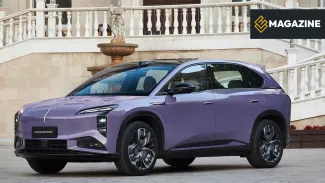
The brand has been laying groundwork for this expansion since last year. In September 2025, Hongqi unveiled plans to launch 15 electric and hybrid models in Europe by 2028 and showed the EHS5, a compact electric SUV with a claimed 550 km range and 10–80% charging in 20 minutes. Leapmotor has also agreed to supply an EV platform to Hongqi, with production expected to start in late 2026.
Stellantis's factory dilemma
For Stellantis, the logic is equally compelling. The Franco-Italian-American conglomerate operates dozens of factories across Europe, many of which are running well below capacity as demand for traditional combustion models softens and the company struggles to align its EV output with market uptake.
Bringing in a Chinese manufacturing partner would improve utilisation rates and generate revenue from assets that might otherwise sit idle or face closure. It is a strategy Stellantis is apparently pursuing on multiple fronts: Bloomberg reported earlier this month that the company is also in talks with Dongfeng Motor about sharing European factories, with Dongfeng representatives recently visiting plants in Germany and Italy.
Stellantis has also been deepening its relationship with Leapmotor beyond simple investment. The two are in advanced talks to jointly develop an Opel-branded electric SUV using Leapmotor's technology, which would also be built at Zaragoza from 2028 with a target output of 50,000 units per year.
The Leapmotor triangle
The deal structure is unusual but increasingly typical of how Chinese brands are entering Europe. In October 2023, Stellantis invested €1.5 billion to acquire roughly 20% of Leapmotor, making it the startup's largest outside shareholder. In December 2025, FAW followed with its own investment, securing a 5% stake.
This shared ownership creates a natural bridge. Rather than trying to build its own factory or acquire one outright — a politically sensitive and capital-intensive process — Hongqi can effectively rent production capacity through a partner that both it and Stellantis already trust.
It is worth noting, however, that the talks are ongoing and may not lead to a final agreement. Hongqi has also explored Hong Kong as a possible production location, which would face fewer tariffs than mainland China but would not offer the same market access as EU-based manufacturing.
What this means for the European EV market
If Hongqi starts building cars in Spain, it will join a growing wave of Chinese brands establishing European production. BYD is building a factory in Hungary, Chery is partnering with Spain's EV Motors, and Changan has already begun shipping Europe-bound vehicles from its Thai plant.
For European consumers, the implications are mixed. More local production generally means shorter delivery times, lower prices and easier access to service networks. At the same time, it raises questions about how EU regulators will treat vehicles that are assembled in Europe but designed, engineered and largely supplied from China.
The European Commission's ongoing trade investigations into Chinese EVs have focused on imports, but as more production shifts to plants like Zaragoza, policymakers may need to reconsider what "made in Europe" actually means in an era of global platform sharing.
Which Hongqi models are already available in Europe?
Hongqi currently sells the EHS9, a full-size electric SUV, in select European markets including Norway, the Netherlands and Poland. The brand plans to introduce the more compact EHS5 and expand to 25 markets by 2028.
Why is Stellantis sharing its factories with Chinese competitors?
Stellantis has significant overcapacity in Europe as demand for traditional combustion models declines. Partnering with Chinese manufacturers allows the company to improve factory utilisation, reduce fixed costs per vehicle and generate revenue from assets that might otherwise be underused.
Would cars built at Zaragoza avoid EU tariffs on Chinese EVs?
Vehicles assembled within the European Union are generally not subject to import duties, regardless of the brand's country of origin. However, the European Commission is investigating whether Chinese-owned plants in Europe could still benefit from state subsidies, which may lead to future regulatory adjustments.