
Listen to this article:
A Milestone Fifteen Years in the Making
Mitsubishi Motors occupies an unusual place in electric vehicle history. In 2009, it launched the i-MiEV — the world's first series-produced battery-electric car — well before Tesla's Model S or Nissan's Leaf had established the category. Then it stopped. For more than a decade, the Japanese brand poured its electrification budget into plug-in hybrids, leaving the pure EV market to competitors.
That changes now. On 26 May 2026, Mitsubishi Motors Europe announced the start of sales for the new Eclipse Cross BEV, a compact electric SUV designed specifically for European buyers. "This is the first all-electric Mitsubishi in Europe since the pioneering i-MiEV, making it a crucial model on our electrification journey," said Frank Krol, president and CEO of Mitsubishi Motors Europe.
The vehicle arrives into a segment that is both the largest and most competitive in Europe — compact electric SUVs — where it will face established players like the Volkswagen ID.4, Škoda Enyaq, Hyundai IONIQ 5, and the mechanically related Renault Scénic E-Tech Electric.
French Bones, Japanese Skin
The Eclipse Cross BEV is manufactured at Renault Group's ElectriCity plant in Douai, northern France, under an OEM agreement between the Alliance partners. It rides on the CMF-EV platform — also known as AmpR Medium — the same architecture that underpins the Renault Scénic E-Tech Electric and the Nissan Ariya.
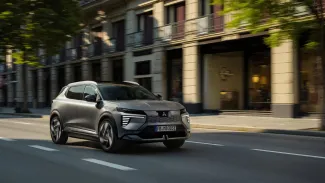
But Mitsubishi's European design studio has given the vehicle a distinctly different personality. The front end features an evolved version of the brand's signature "Dynamic Shield" grille — now rendered in a three-dimensional hexagonal honeycomb pattern in matte chrome. A hexagonal motif repeats at the rear, framed by horizontally arranged LED light strips that give the car a planted, wide-shouldered stance.
"The new Eclipse Cross takes the typical Mitsubishi Motors character a step further, conveying the same driving dynamics in SUV form with modern EV design while giving both driver and passengers a sense of security," said Ryosuke Matsuoka, design general manager at Mitsubishi Motors Europe. The design team coined the concept "Smart Armour" — blending the refinement expected of a modern electric car with visual cues of robustness and protection.
The SUV measures 4,470 mm long, 1,860 mm wide, and 1,570 mm tall, rolling on 19-inch or 20-inch alloy wheels depending on trim. Five exterior colours are available: Volcanic Grey, Crystal White, Sapphire Blue, Sunrise Red, and Onyx Black.
Powertrain: One Motor, Two Batteries
At launch, the Eclipse Cross BEV is offered in a single long-range configuration. A synchronous electric motor with permanent magnets delivers 160 kW (218 hp) and 300 Nm of torque, driving the front wheels through a single-speed transmission. The 0–100 km/h sprint takes 8.4 seconds, with a top speed of 170 km/h.
The 87 kWh battery — the larger of two planned packs — delivers a WLTP range exceeding 600 kilometres. A liquid-cooled thermal management system with a heat pump comes standard, minimising energy drain for cabin heating and helping preserve real-world range in colder conditions.
Mitsubishi has confirmed a medium-range variant will follow later in 2026, likely equipped with a 60 kWh battery — mirroring the Scénic E-Tech's entry-level configuration — though official specifications have not yet been released.
Regenerative braking is adjustable across four levels (B0 to B3) via steering-wheel paddles, allowing the driver to dial in the preferred amount of energy recuperation. An Eco Score function rates driving efficiency on a 100-point scale and offers coaching tips for those who want to squeeze out extra kilometres.
Four drive modes are available through the central display: PERSO (fully customisable), ECO (reduces energy consumption by up to 10%), COMFORT (balanced), and SPORT (sharper throttle response and agility).
Charging: Adequate, Not Class-Leading
On the charging front, the Eclipse Cross BEV supports AC charging up to 22 kW via a Type 2 connector, covering overnight top-ups at home or workplace wall boxes. For longer journeys, DC fast charging peaks at 150 kW through the CCS 2 port — sufficient to replenish from 10% to 80% in approximately 37 minutes, based on the figures Mitsubishi quotes for its Renault sibling.
The 150 kW ceiling is modest by 2026 standards, where vehicles like the Hyundai IONIQ 5 and Kia EV6 on 800-volt architectures can pull over 230 kW. For drivers who regularly cover long motorway distances, this remains a tangible limitation worth considering.
Interior: Light, Sound, and Space
Inside, the Eclipse Cross BEV aims to blend practicality with a premium atmosphere. The headline feature is an electrochromatic panoramic glass roof that switches between opaque and transparent at the press of a button — a feature still rare in the compact SUV class. After dark, a 48-colour LED ambient lighting system can shift tones to match the selected drive mode or the driver's mood.
The cabin seats five across two rows. With the rear seats pushed fully forward, boot capacity stands at 478 litres; fold them flat and the space expands to 1,670 litres. ISOFIX anchors are provided on both outboard rear seats and the front passenger seat.
A 12.3-inch vertical infotainment display serves as the digital hub, running Google built-in — meaning Google Maps, Google Play, and Google Assistant are integrated natively without requiring a paired phone. Wireless Apple CarPlay and Android Auto are also supported. A second 12.3-inch screen behind the steering wheel handles instrumentation.
The optional Harman & Kardon premium audio system pushes 410 watts through 10 channels, including two dashboard tweeters, front and rear door speakers with dual voice coils, and a boot-mounted subwoofer. Five listening modes — Studio, Podcast, Concert, Club, and Immersive — let occupants tailor the sound profile.
Safety and Driver Assistance
Mitsubishi has equipped the Eclipse Cross BEV with up to 20 advanced driver assistance systems (ADAS), fed by a sensor suite comprising 12 ultrasonic sensors, four cameras, and a front radar providing 360-degree coverage.
The centrepiece is MI-PILOT (Mitsubishi Intelligent Pilot), a Level 2 semi-autonomous system combining adaptive cruise control with stop-and-go functionality and lane-centring assistance. It can manage speed and steering on motorways and in traffic jams, with three user-selectable modes — Manual, Automatic (Road Context), and Automatic (Legal Speed). The driver can override the system at any time.
Standout safety features include Rear Automatic Emergency Braking, which detects obstacles during low-speed reversing manoeuvres, and a multi-collision brake that automatically applies the brakes after an initial impact to prevent secondary collisions. Seven airbags, including a front-centre unit between the driver and passenger, round out the passive safety package.
For emergency responders, a pyrotechnic disconnect automatically isolates the high-voltage battery upon airbag deployment, and a dedicated access port allows fire crews to flood the battery casing with water if necessary.
The Warranty Advantage
Perhaps the Eclipse Cross BEV's strongest differentiator in a crowded market is Mitsubishi's warranty package. The standard factory warranty covers 5 years or 100,000 km, extendable by an additional 3 years or 60,000 km under specific conditions — bringing the total to 8 years or 160,000 km.
The traction battery carries its own 8-year, 160,000 km warranty, matching or exceeding most European and Korean competitors. A 12-year anti-perforation warranty and up to 15 years of roadside assistance through the Mitsubishi Assistance Package further sweeten the ownership proposition.
In a segment where buyers increasingly view EVs as long-term purchases, such comprehensive coverage could tip the scales — particularly for private customers wary of battery degradation or out-of-warranty repair costs.
What It Means for Europe
The Eclipse Cross BEV represents more than a new model for Mitsubishi; it signals the brand's intent to remain relevant in a European market that is electrifying faster than almost anywhere else on earth. In April 2026, battery-electric vehicles accounted for 38% more registrations in the EU than the same month a year earlier, and the compact SUV segment is where much of that growth is concentrated.
By leveraging Renault's manufacturing footprint and platform investment, Mitsubishi avoids the enormous capital expenditure of developing a bespoke EV architecture while gaining access to a proven, competitive product. The gamble is whether the Mitsubishi badge, design language, and warranty package are enough to persuade buyers to choose it over the deeply competent Scénic E-Tech — or the growing wave of Chinese alternatives now landing in Europe.
Pricing has not yet been announced, but given the Scénic E-Tech Electric 220 Long Range currently starts at around €47,900 in most European markets, the Eclipse Cross BEV is expected to land in a similar bracket. Official figures and a full trim-level breakdown are expected in the coming weeks.
Is the Mitsubishi Eclipse Cross BEV just a rebadged Renault Scénic?
Mechanically, yes — both vehicles share the CMF-EV platform, battery, motor, and are built on the same production line at Renault's Douai plant in France. However, Mitsubishi's European design team has applied unique front and rear styling, a different interior treatment with brand-specific materials and ambient lighting, and Mitsubishi's own ADAS tuning, MI-PILOT system, and warranty package. The ownership experience and visual identity differ meaningfully from the Scénic.
What charging speed does the Eclipse Cross BEV support?
The Eclipse Cross BEV supports AC charging up to 22 kW (Mode 3, Type 2) for home and workplace charging, and DC fast charging up to 150 kW via CCS 2. A 10–80% charge takes approximately 37 minutes at a 150 kW station. This is competitive but not class-leading — vehicles on 800-volt architectures such as the Hyundai IONIQ 5 can charge significantly faster.
When will the medium-range version be available?
Mitsubishi has confirmed a medium-range variant will follow later in 2026, but has not yet specified the exact launch date or battery capacity. Based on the shared CMF-EV architecture with the Renault Scénic E-Tech, it is widely expected to feature a 60 kWh battery pack with a range in the region of 420–430 km, targeting buyers with lower daily mileage requirements and a tighter budget.