
Listen to this article:
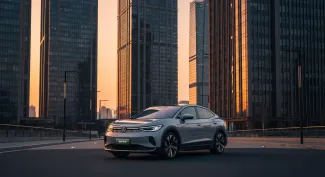
Volkswagen Anhui, the joint venture tasked with revitalising VW's electric lineup in China, officially launched the ID. Unyx 07 on 23 May 2026. The vehicle is built on the CEA (China Electronic Architecture) platform, a system co-developed with Xpeng that replaces the older MEB-based electronics stack. The result is a 4,853 mm-long sedan — roughly the footprint of a European Passat — with a coupe-style silhouette, 19-inch wheels, and an illuminated golden VW badge set into a U-shaped front fascia. Under the skin sits a single rear-mounted motor producing 170 kW (228 hp), fed by a 60 kWh lithium iron phosphate (LFP) battery that delivers 558 km of CLTC-rated range. A top speed of 160 km/h positions it firmly as an urban and highway commuter rather than an Autobahn cruiser.
The technical collaboration with Xpeng represents a strategic pivot for Volkswagen, whose China sales plummeted 46.7% year-on-year in April 2026 to just 77,995 units. VW's in-house software unit Cariad has struggled to deliver competitive digital experiences, pushing the Wolfsburg group to seek external partners. Xpeng, one of China's most software-forward EV makers, provides both the electronic architecture and the advanced driver-assistance stack. The ID. Unyx 07 consequently offers two ADAS tiers: a standard vision-based system with highway Navigate on Autopilot, and a LiDAR-equipped variant — arriving by the end of 2026 — capable of urban NOA. Cross-level parking across distances of up to 2 km comes standard, allowing the car to navigate multi-storey car parks autonomously. Volkswagen has also confirmed that a version with a larger battery pack is in development, suggesting the CEA platform has headroom for more premium variants.
Inside, the ID. Unyx 07 makes a clear statement about Chinese market expectations. A 15-inch 2K floating central touchscreen sits alongside a separate 12-inch 2K display for the front passenger, while a 27-inch augmented-reality head-up display projects key driving data onto the windshield. The infotainment runs on a Qualcomm 8676 chipset and integrates an AI large language model capable of semantic reasoning and natural voice recognition. A 12-speaker HiFi audio system, 30-colour ambient lighting, and a 1.6-square-metre panoramic glass roof complete the cabin. Cargo space is a practical 711 litres in standard configuration, expanding to 1,580 litres with the rear seats folded — figures that rival many European estate cars.
The pricing is the figure that will resonate most painfully with European readers. The base "Pure" trim carries an official guide price of ¥129,900 (€19,100), but a limited-time launch promotion slashes it to ¥109,900 — approximately €15,000 at current exchange rates. Even the higher-spec Pure SE comes in at ¥119,900 (€17,600) with the introductory discount. For context, Volkswagen's own ID.7 sedan starts at approximately €57,000 in Germany. The staggering price gap reflects not only lower Chinese manufacturing and battery costs but also the ferocious competitive pressure from domestic players like BYD, Xpeng, and Xiaomi, whose electric sedans routinely undercut legacy automakers on price while matching or exceeding them on software and connectivity.
For European buyers, the immediate question is whether the CEA architecture — and the models built on it — will cross borders. Volkswagen has already signalled that its China-developed EVs could reach Europe, with the ID. Era 9X and the Audi E7X both cited as potential export candidates. The ID. Unyx 07 itself, however, remains firmly a China-market product for now. European homologation requirements, different charging standards, and VW's commercial need to protect its ID.7 pricing would all complicate any Western launch. What is far more likely is that the software and electronic architecture refined through the Xpeng partnership will trickle into future European VW models — a behind-the-scenes technology transfer that could meaningfully accelerate the competitiveness of next-generation ID. vehicles on this side of the world. The message from Wolfsburg is increasingly blunt: if the group cannot build world-class software internally, it will source it from partners who can. The ID. Unyx 07 is the proof of concept.
Will the VW ID. Unyx 07 be sold in Europe?
As of May 2026, Volkswagen has not announced plans to bring the ID. Unyx 07 to Europe. The vehicle is designed specifically for the Chinese market under the Volkswagen Anhui joint venture and uses a CLTC-rated range figure that would not translate directly to WLTP standards. While VW has indicated that some China-developed EVs like the ID. Era 9X could eventually be exported, the ID. Unyx 07's LFP battery chemistry, pricing structure, and feature set are tailored to Chinese market conditions. European homologation, CCS charging compatibility, and VW's existing ID.7 positioning would all present significant hurdles.
What does the VW-Xpeng partnership mean for future European Volkswagens?
The CEA electronic architecture co-developed with Xpeng is likely to influence Volkswagen's global EV platform strategy. The partnership gives VW access to Xpeng's advanced driver-assistance software, AI-powered infotainment, and over-the-air update capabilities — precisely the areas where VW's in-house Cariad unit has struggled to deliver. Technology validated through the ID. Unyx 07 and other forthcoming China-market models could be adapted for next-generation ID. vehicles sold in Europe, potentially narrowing the software gap between legacy European automakers and their Chinese rivals within this decade.
Why is the ID. Unyx 07 so much cheaper than European VW electric cars?
Three structural factors drive the price difference. First, China's mature EV supply chain — particularly for LFP batteries — enables significantly lower bill-of-materials costs. Second, intense domestic competition from brands like BYD, Xpeng, and Xiaomi forces aggressive pricing that leaves little margin for legacy premiums. Third, Chinese-market vehicles carry different regulatory compliance costs and often feature specifications optimised for local conditions. Labour costs, logistics, import tariffs, and VW's deliberate European brand positioning further inflate the gap. The result is a market where a mid-size electric sedan costs less than a third of its European equivalent.