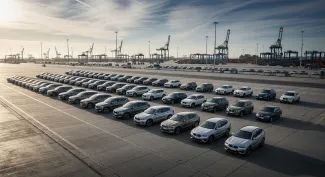
When a company that has been moving goods since 1854 decides to electrify its entire car fleet in one decisive move, it signals something bigger than a sustainability checkbox. Katoen Natie, the Antwerp-based logistics powerhouse present in 36 countries and employing roughly 13,000 people, has just placed an order for more than 1,000 electric vehicles from BMW Group — a deal BMW describes as the single largest order for electric company cars from one manufacturer in Belgium's history.
The fleet will include the BMW iX1, the all-electric Mini Countryman, and vehicles from BMW's Neue Klasse generation — namely the new BMW iX3 and BMW i3. All deliveries are expected to be completed by the end of 2027, replacing existing combustion-engine models across the Belgian operations.
Not a project — a strategy
What makes this deal stand out is not just the volume. Katoen Natie's Chief Procurement Officer Joris Verheulpen was clear about the intent: "For us, electrification is not a standalone project but a logical next step within a broader energy and sustainability strategy."
That broader strategy is already very much in place. The company has solar and wind energy installations at multiple Belgian locations, combined with battery storage and intelligent energy management systems. The incoming EVs are designed to integrate into this existing ecosystem — charging when renewable generation is high and grid pressure is low. In other words, Katoen Natie isn't simply buying electric cars. It is adding 1,000-plus mobile energy assets to an infrastructure it has been quietly building for years.
Why BMW — and why now
The relationship between Katoen Natie and BMW Group is not new. The two companies already work together in automotive logistics in Thailand, where Katoen Natie supports BMW's production operations. Choosing BMW as the exclusive supplier for this fleet transition therefore has a logic beyond the product specs alone.
On the BMW side, the timing is significant. The new iX3 — one of the anchors of BMW's Neue Klasse rollout — has faced extraordinary demand across Europe, with order books stretching well into 2026. BMW was forced to boost iX3 production in January of this year just to keep pace. Katoen Natie's order adds another major vote of confidence in the model's platform, and in BMW's ability to deliver at scale to corporate customers.
The broader market context is equally telling. Corporate and fleet buyers account for roughly 60% of all new car registrations in Europe. In the first half of 2025, European companies registered more than 400,000 Made-in-EU electric vehicles — more than twice the number bought by private individuals. Surveys indicate that around two-thirds of large European companies plan to expand their electric fleets within the next two years, with the EU preparing binding EV purchase targets as part of its Automotive Package.
A blueprint for large-scale fleet electrification
The Katoen Natie deal offers a concrete blueprint for what successful large-scale fleet electrification looks like. Rather than piecemeal replacement, the company is converting in bulk, which allows for systematic infrastructure investment and energy management planning. Rather than mixing suppliers, it is standardising on one manufacturer's ecosystem — simplifying maintenance, driver training and software integration.
Charging infrastructure at Belgian sites will use intelligent load management, designed to align charging demand with available renewable generation and grid capacity. This approach not only reduces energy costs but positions the fleet as an active participant in grid balancing — a concept increasingly valued by utilities and regulators alike.
Katoen Natie's roots in Antwerp's port go back to 1854, when it began as a cotton-handling cooperative (the name "Katoen" is Dutch for cotton). Today it handles chemicals, plastics, automotive parts, containers and consumer goods across five continents. The scale and complexity of its logistics operations make the energy and fleet management challenge genuinely demanding — which is precisely why the company's integrated approach is worth watching.
As Europe's largest fleets move toward electrification not as an exercise in public relations but as a structural energy decision, orders like this one will become the norm rather than the exception. Belgium may be a small country, but in the world of port logistics and EV fleet transitions, Katoen Natie's commitment carries outsized weight.
Which BMW electric models are included in the Katoen Natie order?
The order includes the BMW iX1, the all-electric Mini Countryman, and Neue Klasse models — the BMW iX3 and BMW i3. BMW did not provide a detailed breakdown of the split between models.
When will the 1,000 electric vehicles be delivered to Katoen Natie?
All deliveries are expected to be completed by the end of 2027, replacing the company's existing combustion-engine fleet in Belgium.
How will Katoen Natie charge so many electric vehicles at its sites?
The company plans to invest in on-site charging infrastructure with intelligent load management, integrating EV charging with its existing solar panels, wind turbines and battery storage systems to align consumption with renewable energy generation and minimise grid pressure.
Source: https://www.electrive.com/2026/06/08/katoen-natie-orders-over-1000-electric-cars-from-bmw/