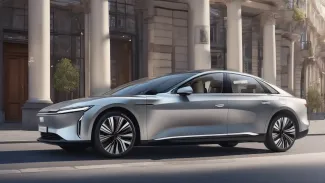
A Journalist Drives It — And Doesn't Want to Give It Back
Automotive journalist Kevin Williams recently had the opportunity to put the updated Xiaomi SU7 Max through its paces — and his conclusion was blunt: "If Xiaomi brings the SU7 to Europe as is, I think they'll have a hit." That's a striking statement about a car that has never officially turned a wheel on European soil, and it says as much about the quality of the product as it does about the state of the European EV market.
Williams isn't alone in his admiration. It has been widely reported that Ford's CEO was reportedly reluctant to hand the car back after getting behind the wheel. That anecdote has circulated in industry circles for months, and after spending time with the refreshed SU7, it's easy to understand why.
What the Updated SU7 Max Brings to the Table
The model tested is the Xiaomi SU7 Max, the range-topping variant powered by a dual-motor system producing 680 horsepower via Xiaomi's own proprietary electric motors — no outsourcing, no third-party components at the core of the drivetrain. The battery pack measures 101.7 kWh, delivering a claimed range of up to 519 miles on the CLTC cycle — China's city-biased test standard which typically reads more optimistically than WLTP. European drivers should expect real-world figures closer to what WLTP would suggest, likely in the 580–640 km range depending on conditions, though official WLTP homologation for Europe has not yet been completed.
The refreshed version is not a minor update. Xiaomi has overhauled the chassis, powertrain calibration, interior design, and suspension systems. The result, according to Williams, is a car that delivers smooth, refined ride quality paired with genuine driving engagement — the combination that European buyers expect from premium saloons.
Porsche Taycan Levels of Refinement — at a Different Price
Perhaps the most telling detail in Williams's assessment is the benchmark he reaches for: the Porsche Taycan. The SU7 Max, he argues, matches the German sports saloon's refinement and driving dynamics — while being available in China at a price significantly below what a Taycan commands anywhere in the world. In China, the SU7 undercuts the Tesla Model 3 on price, positioning it as premium yet accessible.
That pricing logic has proven devastatingly effective in the Chinese market. Xiaomi's smartphone brand credibility, combined with software-first thinking and vertical integration — the company makes its own motors — has attracted buyers who might otherwise have chosen a BMW 3 Series or a Tesla. In just two years, the SU7 has accumulated over 380,000 deliveries, a figure that established European premium brands would struggle to match across their entire electric lineup.
What Would Europe Actually Need?
The key question for European importers and regulators is always type approval — the formal process of certifying a vehicle meets EU safety, electromagnetic compatibility, and emissions standards. Williams's assessment implies the engineering quality is there. What remains is the regulatory and logistical process: WLTP homologation, right-hand drive variants for markets like the UK, Euro NCAP crash testing, and the establishment of a service network.
Xiaomi has not yet announced a formal European launch timeline for the SU7. The company's focus has been on scaling production in China, where demand has consistently outpaced capacity. However, the sheer quality of the product — combined with Xiaomi's deep familiarity with European consumer electronics markets — makes Europe a logical next step. Xiaomi already sells smartphones, laptops, and smart home devices across Germany, France, Spain, the UK, and dozens of other European markets. A car showroom is a different proposition, but the brand recognition is already there.
A Market That Is Ready to Be Surprised
European EV buyers have spent several years watching Chinese manufacturers arrive with promising hardware and then stumble on software, after-sales support, or pricing that didn't quite work. The SU7 reviewed here suggests Xiaomi may have cleared the hardest hurdle: product quality that genuinely stands comparison with the best from Germany and Japan.
The 680 hp SU7 Max is not a mass-market product — it's a statement. But Xiaomi also offers more accessible variants with smaller batteries and single-motor configurations, which could serve as the actual volume drivers in Europe if and when the brand makes its move. The standard SU7 has a more modest footprint and a price in China well below €25,000 at current exchange rates, though European pricing will inevitably be higher once local costs, tariffs, and logistics are factored in.
For now, Europe is watching. And based on this test drive, it should be watching very closely.
When will the Xiaomi SU7 be available in Europe?
As of mid-2026, Xiaomi has not announced a confirmed European launch date for the SU7. The company remains focused on scaling production in China, where demand has exceeded supply since the 2024 launch. European type approval, including WLTP homologation, would be required before sales can begin.
How does the Xiaomi SU7 Max range compare to European rivals?
The SU7 Max claims up to 519 miles (approximately 835 km) on the Chinese CLTC cycle. CLTC figures are typically more optimistic than WLTP, so European real-world range is likely in the 580–640 km range — competitive with the Mercedes EQE and BMW i5, and ahead of many rivals in this segment.
Is the Xiaomi SU7 cheaper than Tesla in Europe?
In China, the SU7 is priced below the Tesla Model 3. European pricing has not been announced, and would likely be higher due to import logistics, EU homologation costs, and potential tariff considerations. However, Xiaomi's strong vertical integration and manufacturing scale give it structural cost advantages that could translate into competitive European pricing.
Source: https://insideevs.com/reviews/799960/su7-video-update-watch-xiaomi/