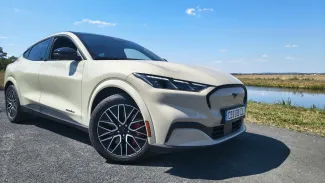
The Mustang badge is only half the story
The Ford Mustang Mach-E arrives with a name that sets a clear expectation. It should be quick, visually distinctive and more engaging than the average family SUV. After spending time with the Extended Range rear-wheel-drive version, we found that the car largely delivers on that promise. It has enough performance for effortless overtaking, a well-controlled chassis and a cabin that combines a huge central screen with something increasingly unusual in new EVs: a generous selection of physical buttons and rotary controls.
That is not, however, what stayed with us after the test. The Mach-E became most revealing when we stopped judging it as a fast electric SUV and started looking at how it shares the driving with its human driver. We currently have a Tesla Model 3 in the editorial fleet, and we have also used XPENG’s assistance system extensively on a 3,450-kilometre trip to Italy. That gave us an unusually useful reference point.
BlueCruise is convincing where Ford says it should be used
Ford’s BlueCruise is a Level 2 driver-assistance system, not autonomous driving. The driver remains responsible for the vehicle and must be ready to take over. Its strongest performance came on the motorway, where the system kept the Mach-E in its lane, maintained the selected speed and made long, straight sections noticeably less tiring.
We were able to use BlueCruise on Czech motorway sections during the test. In that environment it felt composed rather than theatrical. The car did not constantly make small, nervous corrections, and the system’s operation was easy to understand. It is the kind of assistance that can make a long motorway journey more comfortable, provided the driver treats it as support rather than a replacement for attention.
The contrast appeared as soon as the road became less predictable. We also tried the system on ordinary secondary roads and on bends outside the motorway environment. When a curve became sharper, the Mach-E could announce that the driver needed to take over while already in the bend. Ford is clear that BlueCruise is designed for suitable divided highways, so this is not a failure to meet an off-road promise. It is nevertheless an important practical limitation: if the system is left active in a situation it cannot confidently handle, the handover can feel abrupt.
That was particularly uncomfortable in places where the next bend was not easy to read in advance, including darker conditions. A warning that arrives before the difficult section is useful. A warning delivered in the middle of a turn is a different experience, especially when the driver has just allowed the assistance system to take over the routine work. We did not use the system on roundabouts, and we would not describe BlueCruise as a convincing solution for urban driving or winding country roads.
How it compares with XPENG and Tesla
Our comparison with XPENG is based on a much longer journey. During the 3,450-kilometre drive to Italy, we used the Chinese manufacturer’s driver-assistance system extensively on motorways, outside built-up areas and, in suitable situations, in towns. We deliberately excluded complex situations such as roundabouts from that assessment.
On the motorway, XPENG’s system worked very well for the conditions in which we used it. It held the lane and speed without repeatedly startling the occupants. We would not call it flawless, but it was sufficiently polished to become a useful part of a long journey. The important difference is not that it can somehow drive without supervision. It is that its behaviour often felt more predictable when the road was no longer perfectly straight.
The Tesla Model 3 in our current fleet offers a different interpretation. Its standard assistance package is not Tesla’s Full Self-Driving system, nor is it the version for which the company is seeking broader approval in Europe. In the configuration we are testing, the system handles motorway driving in a fairly conventional way: it keeps the car between the lane markings and maintains speed. On a straight motorway section, it can work well for several kilometres.
There are occasional moments when the Tesla makes an unnecessarily sharp correction or reacts cautiously to an unclear traffic situation. It is also not a system that simply carries the car from one lane to the next without the driver’s involvement. When a lane change is required, the driver indicates, the assistance temporarily gives up lateral control, and the driver moves the car into the adjacent lane before the system resumes.
That approach is less ambitious than a fully automated motorway experience, but its limitations are relatively easy to understand. The Ford is more impressive when BlueCruise is operating inside its intended motorway environment. Away from that environment, the system’s sudden requests for intervention can be more surprising. XPENG, based on our long-distance experience, has shown a particularly good balance between capability and smoothness, although the exact equipment and software version matter.
The rest of the Mach-E is a convincing compromise
Driver assistance is only one part of the car. The Mach-E remains a practical family vehicle with a distinctive driving character. Its suspension is firmer than some rivals, which helps in corners but makes damaged asphalt more noticeable. The front seats did not suit us perfectly, and the lack of seat ventilation was disappointing in the tested black leather interior.
Our real-world figures also show why motorway driving matters. After a mixed test route of 474.4 kilometres, the trip computer recorded 16.0 kWh/100 km. On the motorway section, the average rose to around 20 kWh/100 km, while the car recorded approximately 15 kWh/100 km before reaching the motorway. These are observations from one test in warm weather, not laboratory results, but they illustrate the difference speed makes in a large electric SUV.
The car’s maximum DC charging specification is up to 150 kW. We recorded a peak of 132 kW at a 200 kW fast-charging station. That is a usable result, although newer 800-volt competitors demonstrate how much shorter long-distance charging stops can become.
Inside, the large display is visually dominant, but Ford has not followed Tesla all the way into a touch-only philosophy. Physical controls remain available for several everyday functions. The software is not as immediately coherent as Tesla’s, yet the cabin is easy to live with once the driver learns where the important settings are. There is also useful passenger and luggage space, including a front storage compartment for charging equipment or smaller bags.
Verdict: good motorway assistance, not a licence to stop thinking
The Ford Mustang Mach-E is a strong choice for drivers who want a practical electric SUV without giving up a more engaging road presence. The measured consumption, 132 kW charging peak and firm suspension all come with compromises, but the car has genuine character and enough space for family use.
BlueCruise adds real value on suitable motorways in the Czech Republic and elsewhere in Europe where the system is supported. It is smooth and useful in that environment. The lesson from our test is not that Ford’s approach is unsafe or unsuccessful; it is that the boundary of its confidence can arrive quickly on a sharper bend. That boundary should be understood before the driver begins to rely on it.
Compared with the systems we have recently used in the Tesla Model 3 and on our long XPENG journey, Ford’s solution sits somewhere between clear motorway competence and unfinished ambition beyond it. The Mach-E is therefore not a self-driving car. It is a good electric SUV with a helpful motorway assistant — and a reminder that the person behind the wheel still has the most important sensor in the vehicle.
Is Ford BlueCruise autonomous driving?
No. BlueCruise is a Level 2 driver-assistance system. The driver must remain attentive, monitor the road and be ready to take control at any time.
Where did BlueCruise work best in the Mustang Mach-E?
In our test, it worked best on suitable motorway sections, where it maintained the lane and speed smoothly. We found it less convincing on ordinary roads and sharper bends.
How fast did the tested Mustang Mach-E charge?
Ford lists up to 150 kW for the tested version. We recorded a peak of 132 kW at a 200 kW fast-charging station.
Source: https://www.evmagazin.cz/jeli-jsme-fordem-mustang-mach-e-hned-po-usednuti-nas-cekalo-prekvapeni