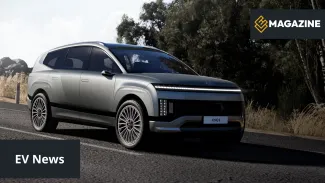
Hyundai's two-track plan: Nvidia first, Atria AI second
Hyundai Motor Group used its HMG Autonomous Driving Media Day on Saturday to lay out a two-phase strategy. The first phase is a Level 2+ system running on Nvidia's Drive Hyperion 10 architecture, which Nvidia says can scale from supervised Level 2 assistance all the way to unsupervised Level 4 autonomy. Production cars with that hardware and software start rolling out in the second half of 2028.
The second phase is Atria AI, Hyundai's own end-to-end system — a single AI model that takes sensor input and outputs driving commands, rather than a stack of hand-written rules layered on top of each other. It was originally pencilled in for around 2027; Reuters reports the target has now moved to the second half of 2029. Hyundai labels it "Level 2++", industry shorthand for assistance that is markedly more capable than today's systems but still requires a human supervisor.
The first phase will rely on cameras, ultrasonic sensors and radar — no lidar. An executive said lidar could be added later for Level 3 systems. That is the same sensor philosophy Mercedes-Benz uses for its Nvidia-based MB.Drive Assist Pro, and broadly the same one Tesla has pursued for years.
"We made a strategic decision to slow down"
"We made a strategic decision to slow down," Park Min-woo, head of HMG's advanced vehicle platform division, told Korea JoongAng Daily. "Rushing into mass production now risks delivering a middling Level 2++ system, far short of our real target."
The mechanism behind that bet is what Hyundai calls a data flywheel: real-world driving data goes in, models are retrained, results are validated, and updated software is pushed back out to the fleet. Roughly 40 dedicated data-collection vehicles are on the road today, with more than 200 autonomous test vehicles due to be deployed in Gwangju in the second half of 2026. The company expects to pass rivals on accumulated driving data by 2033, according to its own roadmap.
Junghyun Kwon, who heads HMG's autonomous driving development centre, framed the strategy bluntly: "Autonomous driving competitiveness depends not on how much data you secure, but on how rapidly you can connect data to learning, validation and performance improvement."
What Level 2+, 2++ and 3 actually mean
The SAE J3016 scale is the reference point. At Level 2 the driver supervises at all times — hands may be off the wheel on some systems, but eyes stay on the road and the human is legally responsible. At Level 3 the car can drive itself within defined conditions and the driver may look away, but must be ready to take back control when asked.
Level 2++ sits in the awkward space between. Practically, that means a car that can handle a point-to-point urban route with the driver monitoring, not a car you can nap in. It is the same category Tesla's Full Self-Driving (Supervised) occupies — and it is worth remembering that FSD, despite the name, remains a supervised Level 2 system.
Genuine Level 3 in Europe is still close to a one-horse race. Mercedes-Benz's Drive Pilot is the only UN-R157-certified Level 3 system on sale in Germany, originally capped at 60 km/h in traffic jams and raised to 95 km/h from 2025.
Why Europe is the harder market to crack
Hyundai's 2028 Nvidia platform will have to clear a regulatory wall that has nothing to do with how good the neural network is. UNECE regulation R157 governs Automated Lane Keeping Systems, and the amended version allows Level 3 motorway driving up to 130 km/h — but only on roads and in conditions the manufacturer has explicitly validated, country by country.
Tesla has been navigating exactly this maze. The Dutch RDW gave FSD Supervised a provisional green light in April 2026, only for the process to stall when an EU committee held back its vote in May after safety concerns were raised by Nordic regulators. The wider battle between Tesla's FSD and European regulators is a decent preview of what Hyundai will face in 2028 and 2029.
Separately, the EU's General Safety Regulation has mandated a baseline of driver-assistance technology on every new car sold since July 2024 — intelligent speed assistance, drowsiness warnings, emergency lane keeping. That raises the floor, but it does not raise the ceiling: it makes Level 2 features universal, not Level 2++ available. If you want to compare what today's Hyundai and Kia EVs actually deliver in Europe — battery size, WLTP range, charging speed — our EV specification database lists 67 models with real-world as well as WLTP figures.
Robotaxis first, showrooms later
Hyundai's autonomy ambitions reach well beyond private cars. The group expects its first Ioniq 5 robotaxis through its AV division Motional to hit Las Vegas streets by the end of 2026, and it is supplying Ioniq 5 robotaxis to Waymo on a similar timescale. Its Boston Dynamics subsidiary keeps the group in humanoid robotics at the same time. For European readers, the practical takeaway is that today's Euro-spec Hyundai and Kia models ship with Highway Driving Assist-style systems and nothing beyond that — the 2028 Nvidia platform is the first realistic chance of something genuinely new on this side of the Atlantic.
| System | Sensors | SAE level | Timing | Key point |
|---|---|---|---|---|
| Hyundai + Nvidia (Drive Hyperion 10) | Cameras, radar, ultrasonic — no lidar | Level 2+ (supervised) | H2 2028 | Bridges the gap while Atria AI matures |
| Hyundai Atria AI (in-house) | End-to-end AI, sensor set not yet detailed | Level 2++ (supervised) | H2 2029 | Two years later than the original plan |
| Tesla FSD (Supervised) | Cameras only | Level 2 (supervised) | Live in North America; provisional Dutch RDW nod, April 2026 | EU-wide approval still unresolved |
| Mercedes-Benz MB.Drive Assist Pro | Cameras, radar — no lidar | Level 2 (supervised) | On sale in Europe | Also built on Nvidia's Hyperion platform |
Will Hyundai's Atria AI come to Europe?
Hyundai has not confirmed a market-by-market rollout, but Europe is one of the group's largest regions, so the system will almost certainly be offered here. The timing, however, will depend on a country-by-country type-approval process that has already slowed Tesla's FSD Supervised considerably — a 2029 Korean launch does not automatically mean a 2029 European one.
What is the difference between Level 2+ and Level 2++?
Both are supervised systems, meaning the driver remains legally responsible and must stay engaged. Level 2+ typically covers motorway driving and lane changes; Level 2++ extends that to point-to-point urban routes with traffic lights, junctions and pedestrians, but still without the driver being allowed to disengage attention the way Level 3 permits.
Do I need to buy a new car to get these features?
Yes. Hyundai's Nvidia-based Level 2+ relies on the Drive Hyperion 10 architecture, which is hardware as well as software. Existing Ioniq 5, Ioniq 6, Kona Electric or Inster owners should not expect a retrofit — the rollout starts with vehicles built from the second half of 2028.