
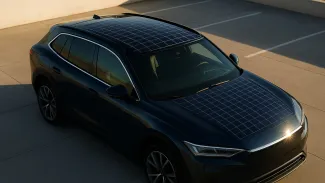
What Hongqi actually built
The prototype sits in the panoramic glass roof of the EHS7, the large electric SUV that Hongqi already sells in Europe. Instead of the usual crystalline silicon, the engineers chose perovskite, a calcium titanium oxide material that can be printed in thin, light layers with enough flexibility to follow gentle curves. Silicon cells are efficient but rigid and heavy, which is why they fit poorly on curved car glass.
Perovskite has known weaknesses, and Hongqi listed them honestly. The material degrades on contact with water and oxygen, and ultraviolet radiation wears it down too. Curving the glass made the job harder still. The company says it solved the encapsulation problem in its research center; how the cells cope with five winters and a thousand automatic car washes is a question nobody can answer yet.
The output figures are concrete. Under strong sunlight the roof delivers 300 W, which Hongqi expects to add up to roughly 400 kWh over a year. That energy feeds the low-voltage systems rather than the traction battery. Air conditioning while parked is the obvious win. A camping fridge or sentry mode can draw from the same pool without touching the big battery at all.
Two Chinese routes to the same goal
Hongqi is not alone. Just over a week earlier, our Czech edition covered Fuyao Glass, the world's largest automotive glass supplier, as it announced production readiness for solar sunroofs built on heterojunction silicon cells with 23.18 percent efficiency. Fuyao quotes up to 720 Wp per roof and a reported price around 8,000 yuan, roughly 1,000 euros per car.
The two approaches differ in an interesting way. Fuyao laminates proven silicon between layers of safety glass, the same craft that has kept windshields alive for decades. Hongqi bets on perovskite, which is lighter, cheaper and easier to shape into curved, tinted surfaces. In laboratories, perovskite-silicon tandem cells have passed 34 percent efficiency, well beyond anything silicon alone can reach.
If solar roofs become a normal paid option, Fuyao's route gets there first. The company supplies glass to carmakers across three continents, Europe included. Hongqi's route could win later, but only if the chemistry survives real-world abuse.
What 400 kWh a year really means
Let us do our own calculation, because the headline number hides a geography lesson. 400 kWh a year averages out at 1.1 kWh a day. For a 300 W roof that implies about 3.6 full sunshine hours daily. That is realistic in central China or southern Spain. It is optimistic further north, where a horizontal car roof collects the equivalent of roughly 2.3 to 2.6 hours a day, so a Central European owner should expect nearer 250 to 300 kWh.
At a real-world consumption of 16 kWh/100 km, that converts to between 1,700 and 2,500 km of driving a year, or 5 to 7 km a day. For comparison, Hyundai's official figure for the solar roof in the Sonata Hybrid was 1,300 km annually. Hongqi's roof roughly doubles that. For further perspective, Lightyear promised up to 70 km a day from its 0 model before the company collapsed in 2023.
The practical wins are humbler than the headlines. A cooler cabin on a hot parking lot costs nothing. A fridge keeps running at the campsite. Sentry mode no longer eats 2 kWh of battery on a sunny day. Nothing about this roof replaces a charger, and Hongqi does not claim it does.
The 80 km promise needs a dozen square metres
The ambitious part comes later. Hongqi wants to extend perovskite cells to the hood and other body panels, then talks about 10 kWh a day, enough for up to 80 km of range. By the company's own data that would cover the daily driving needs of more than 85 percent of Chinese car owners. No timeline was offered.
The math is worth doing. Ten kWh a day requires about 2.5 kWp of panels working through four full sunshine hours. At 200 to 220 watts per square metre, typical for perovskite modules today, that means roughly 12 square metres of perfectly sunlit surface. The upward-facing glass and sheet metal of a large SUV adds up to maybe four square metres, roof and hood combined. For calibration, the current 300 W figure implies Hongqi's usable roof area is around one and a half square metres.
Even with future tandem cells at 30 percent efficiency, and even covering every horizontal panel a car has, a vehicle of this size would generate about 5 kWh on an ideal summer day. That is some 30 km of range. Winter cuts it to a fraction. The implied consumption of 12.5 kWh/100 km behind the 80 km claim, meanwhile, is a number this class of SUV will not deliver in daily traffic.
If a production car really managed 80 km a day from its own body surface, it would be a milestone. Physics says that day has not arrived yet.
What it means for European buyers
The EHS7 is not a distant concept. Hongqi opened European pre-sales at the 2024 Paris Motor Show at 53,999 euros, and the car is on sale in Norway and the Netherlands with a 475 km WLTP range. Whether European cars will get the solar roof is an open question. The prototype has no production timeline, and EU tariffs on Chinese-built EVs leave little room for affordable optional extras.
Hongqi is pushing technology on several fronts at once. Next-generation models are set to use BYD's flash charging, refilling the battery from 10 to 97 percent in nine minutes, and a 380 Wh/kg solid-state prototype is already in road testing. The brand delivered 15,445 cars at home in July 2026 as it tries to convert its prestige image into electric volume.
For now, treat the solar sunroof as what it is: a comfort feature that keeps parked electronics alive and pre-cools the cabin. If perovskite survives its first real winters, solar hoods and door panels become worth taking seriously.
Can I order the solar sunroof on a Hongqi in Europe?
No. It is a prototype without a production timeline. Hongqi has not said which model or market gets it first, and the option is not confirmed for European-spec EHS7 cars.
How much range would a 300 W solar roof add in Central Europe?
Our estimate is 250 to 300 kWh a year, roughly 1,700 to 1,900 km of driving, or 4 to 6 km a day on average. Sunny summer days give more, a cloudy December gives close to nothing.
Why perovskite and not silicon?
Perovskite layers are thin, light and cheap to produce, and they adapt to curved, tinted glass. The trade-off is stability: the material is sensitive to moisture and oxygen, and UV light degrades it over time, so long-term durability data for cars does not exist yet.