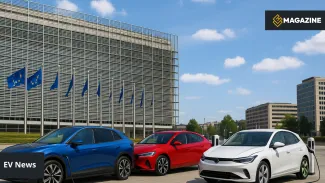
A symbolic bonus with unusually strict rules
The new scheme replaces the old €1,000 state bonus for used EVs, which was scrapped. It is no longer paid from the national budget at all — instead it runs through energy-saving certificates (CEE, Certificats d'Économies d'Énergie), which energy suppliers are obliged to fund. The amount therefore floats with the market value of those certificates rather than a fixed table, as French motoring title L'argus reports.
In practice, a private buyer can expect roughly €300 to €380. Care and field social services — whose staff cover hundreds of kilometres a day — qualify for a far more meaningful €2,000 to €2,400.
The eligibility net is deliberately narrow:
- First registration between 1 January 2017 and 31 December 2023;
- a price cap of €25,000 including VAT;
- a weight limit of 1,800 kg, which rules out larger SUVs;
- battery health (SoH) of at least 80 %, or a proven real-world range of 200 km;
- purchase through a professional dealer only — private sales do not qualify;
- a minimum three-year holding period.
The bigger picture: what France still subsidises in 2026
Is the used-car bonus the only tool France has left? Far from it — but the structure has changed fundamentally.
New cars: the ecological bonus for new EVs did not disappear. Its state budget was cut from €1.5 billion in 2024 to €500 million in 2025, and the pot was exhausted by late June 2025. In July 2025 the government moved the bonus onto the CEE system as the "coup de pouce véhicules électriques". In November 2025, Economy Minister Roland Lescure confirmed it would be extended into 2026 — and increased. For 2026 the amounts were revalued, reaching up to around €5,700 for the lowest-income households. Cars must still cost under €47,000, weigh under 2.4 tonnes and pass the French eco-score, which favours European-built models.
Social leasing: the cut-price leasing scheme for low-income drivers also lives on, refinanced through CEE from September 2025 with an envelope of €369 million over five years (up to €7,000 per vehicle). Monthly rents are capped below €200, and Stellantis advertises eligible models from €95 a month.
What is gone for good: the scrappage premium ("prime à la conversion"), which for years topped up the budget of households trading in an old polluting car, was abolished in December 2024 and has not returned. That is a real gap — it was precisely the mechanism aimed at lower-income drivers who cannot stretch to a new car even with a bonus.
From the state budget to energy companies
There is a single thread running through all of this. Since 2025, Paris has been shifting the cost of electrification off the public budget and onto energy suppliers via the CEE mechanism. It is an elegant way to keep subsidies alive without spending taxpayers' money — but it changes the character of the support. Amounts now track the volatile price of energy-saving certificates rather than a predictable budget line, and eligibility is heavily means-tested toward the lowest income deciles.
For a middle-income household, the 2026 reality is stark: no scrappage premium, a used-car bonus of around €300, and a new-car bonus that, while higher than in 2025, is still reserved for sub-€47,000 models with European eco-scores.
What it means for French EV sales
Will this dent future sales? The answer is nuanced. The new-car pipeline is protected: the bonus for new EVs continues and even grew for low-income buyers, and social leasing keeps a floor under the bottom of the market. France remains one of Europe's largest EV markets, and manufacturers are unlikely to walk away.
The risk sits elsewhere. The used market is where most private households actually buy, and a €300 incentive on a €20,000 car is unlikely to change a purchase decision. Combined with the loss of the scrappage premium, the mass middle of the market now has less support than at any point since 2020. If second-hand EVs do not find buyers, residual values suffer, leasing costs rise, and the whole cycle — new sales today, used supply tomorrow — cools.
The one genuinely positive detail is the 80 % battery-health requirement. By forcing dealers to certify battery condition, France is building the transparency the used-EV market has been missing. That could do more for long-term confidence than a few hundred euros ever would.
Is the French new-car bonus still available in 2026?
Yes. It was renamed the "coup de pouce véhicules électriques" and moved onto the CEE (energy certificate) system in July 2025. It was extended and increased for 2026, reaching up to around €5,700 for the lowest-income households, with the usual caps (under €47,000, under 2.4 tonnes, French eco-score).
Can I combine the used-EV bonus with other French aid?
The new used-car bonus is a CEE scheme and is not cumulative with the classic CEE purchase premiums offered by manufacturers. It also cannot be combined with the scrappage premium, because that scheme was abolished in December 2024.
Does the 1,800 kg weight limit rule out most used EVs?
It excludes heavier electric SUVs, but a large share of used EVs from 2017–2023 — compact hatchbacks such as the Renault Zoe, Peugeot e-208 or Nissan Leaf — sit comfortably under 1,800 kg. In practice the bigger filter is the 80 % battery-health certificate.