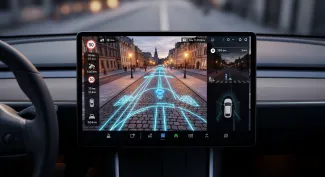
The tension between Silicon Valley's "move fast and break things" ethos and the European Union's "safety first" regulatory framework has reached a new boiling point. As of May 2026, Tesla is making significant efforts to expand its Full Self-Driving (FSD) capabilities across the continent, but the path to widespread consumer availability is being blocked by intense skepticism from European regulators.
The Regulatory Tug-of-War
Recent reports, including those from Electrek, suggest that EU authorities are not convinced by Tesla's current safety data. While Tesla has successfully expanded its testing programs—notably in Spain following a milestone in July 2025—regulators are concerned about the fundamental way the system operates. Unlike the United States, where testing is often more permissive, the EU operates under strict UNECE regulations that demand high levels of predictability and fail-safe mechanisms.
The primary concern for regulators lies in the "vision-only" approach. Tesla relies almost exclusively on eight surround-view cameras to navigate, having famously moved away from radar and ultrasonic sensors in newer models. European safety experts argue that without redundant sensor types like LiDAR (Light Detection and Ranging), the system may struggle with "edge cases"—unpredictable scenarios like heavy fog, sudden glare, or complex urban geometries that cameras alone might misinterpret.
Technical Hurdles: Vision vs. Sensor Fusion
To understand the skepticism, one must look at the technical divide between Tesla and its European competitors. While Tesla aims for a pure neural-network-based vision system, other manufacturers are taking a more conservative, sensor-fusion approach. For example, Mercedes-Benz has already secured approval for its Drive Pilot system in certain European markets, which operates at Level 3 autonomy.
The distinction between these levels is critical for consumers to understand:
- Level 2 (Tesla FSD currently): The driver must remain fully attentive and be ready to take control at any second. The driver is legally responsible for the vehicle's actions.
- Level 3 (Mercedes-Benz Drive Pilot): Under specific conditions (such as highway driving in heavy traffic), the driver can legally take their eyes off the road, though they must be able to intervene when prompted.
Regulators are wary that Tesla is attempting to market a system that feels like Level 3 but legally remains at Level 2, potentially leading to driver over-reliance and dangerous accidents. This concern is echoed by technical critics who point to historical instances where FSD versions have struggled with basic obstacles, such as concrete pylons or non-standard road markings.
The Complexity of the European Landscape
Deploying autonomous software in Europe is significantly more complex than in the US. The continent presents a patchwork of:
- Diverse Road Geometries: From the narrow, winding streets of Mediterranean cities like Madrid to the high-speed Autobahns in Germany.
- Varying Signage and Rules: Traffic light recognition and lane-keeping must be perfect across different jurisdictions.
- Urban Density: High concentrations of cyclists and pedestrians in European city centers require a level of nuance in object detection that many experts believe "vision-only" systems have yet to master.
Tesla's expansion into Spain was a significant step, but it served more as a data-gathering exercise than a full commercial rollout. The company is essentially using the European market to refine its neural networks, but the EU is demanding that this refinement happens in a controlled, highly documented manner before the software is handed over to the general public.
What This Means for the EV Market
For European EV owners, this regulatory friction means that the highly anticipated FSD features may remain locked behind software barriers or limited to specific "Beta" testing groups for much longer than expected. While Tesla owners in the US may enjoy advanced autonomy today, European customers are currently limited to standard Autopilot features, which include adaptive cruise control and lane centering, but lack the full city-street navigation capabilities of FSD.
As the competition intensifies, the winner of the autonomous race in Europe will not necessarily be the company with the most advanced software, but the one that can most effectively prove its safety to the world's most stringent regulators.
Is Tesla FSD currently available for purchase in Europe?
No, full FSD capabilities are not yet widely available for consumer use in the EU. While Tesla is conducting tests in countries like Spain, most European drivers currently only have access to standard Autopilot features.
How does Tesla's approach differ from Mercedes-Benz?
Tesla uses a "vision-only" approach relying on cameras, whereas Mercedes-Benz uses a combination of cameras, radar, and LiDAR to achieve Level 3 autonomy, which allows for hands-off driving in specific conditions.
Why are EU regulators more cautious than US regulators?
The EU follows the "precautionary principle," which requires extensive proof of safety before new technologies are deployed. US regulators often allow for more iterative, real-world testing with the driver remaining responsible.