
The clock is running out
Speaking on Porsche’s first-quarter earnings call, Chief Financial Officer Jochen Breckner put a definitive date on the rumours: production of the petrol-powered Macan will cease in the summer of 2026. “Production will be stopped in summer 2026 and during the last month that we have, we [will] produce as much as we can,” Breckner said. “Of course, our capacity is one factor there, but that’s not limited. Supplier parts are the other issue.”
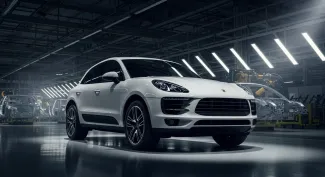
The announcement ends years of speculation about the fate of Porsche’s entry-level SUV. The current Macan, which shares its MLB architecture with the first-generation Audi Q5, has been a volume pillar for the brand since 2014. In the first three months of 2026 alone, Porsche sold 10,130 ICE Macans — actually up from 9,370 in the same period last year.
The electric Macan hasn't taken over yet
When Porsche launched the all-electric Macan in 2024, built on the Premium Platform Electric (PPE) architecture alongside the Audi Q6 e-tron, the plan was clear: the EV would seamlessly inherit the bestseller crown. That transition has proven bumpier than expected.
In Q1 2026, the Macan Electric found 8,079 buyers globally — well below the 14,185 units shifted during the launch-heavy first quarter of 2025. The shortfall is not entirely surprising. Breckner attributed the drop to the “strong ramp-up” of EV deliveries in early 2025, when Porsche pushed hard to get cars on the road immediately after launch, as well as the removal of the $7,500 (approximately €6,900) federal EV tax credit in the United States.
What makes the numbers sting is the regional split. In the US, where the ICE Macan “really has great demand,” the petrol SUV outsold its electric sibling by more than 2,000 units in the first quarter. Porsche is now diverting as much remaining ICE stock as possible to North America, while the model is already unavailable for order in Europe.
A two-year void
Here lies the uncomfortable truth: once the Leipzig line goes quiet this summer, there will be no new combustion or hybrid Macan until 2028. Porsche has green-lit a spiritual successor — codenamed M1 — which will ride on Audi’s Premium Platform Combustion (PPC) architecture and share underpinnings with the third-generation Q5. But development takes time.
“When we take a platform from Audi, we never use it one-to-one without any changes,” Breckner emphasised. “If there are items that we need to change to make a Porsche a Porsche, we do that and invest into the platforms.” The message is clear: even a shared platform must feel like a Porsche. Still, that engineering pride does not close the two-year product gap.
Headwinds beyond product planning
The Macan uncertainty arrives at a difficult moment for Porsche. First-quarter 2026 deliveries fell by nearly 15 percent, automotive revenue slipped 5.6 percent, and operating profit tumbled 23.8 percent. The brand is deliberately retreating from volume-chasing in China, prioritising margin over market share, yet losing a popular model line for two years will not make that balancing act any easier.
External factors are adding pressure. Breckner noted that the conflict in Iran has disrupted key shipping lanes, making some customers “more reluctant” to visit showrooms. In the US, former President Donald Trump’s tariffs on European-built vehicles have already complicated Porsche’s pricing strategy, and the loss of federal EV incentives has cooled demand for the electric Macan precisely when the brand needs it to perform.
What buyers can expect
For European customers, the combustion Macan has already vanished from order books. The remaining stock is being routed to markets with sustained demand — chiefly the United States and, to a lesser extent, the United Kingdom, where Porsche GB has confirmed ICE Macan availability into 2027. Once those dealer lots clear, the only new Macan on offer will be the electric version.
That creates a curious paradox: Porsche, historically the most profitable car maker per vehicle, is being forced into an all-electric Macan strategy in Europe not because EV demand is soaring, but because regulators and supply chains have removed the alternative. In the US, where emissions rules are looser and tariffs on European EVs add complexity, the company is racing to sell every last petrol SUV it can build.
Will the combustion Macan still be available in Europe after summer 2026?
No. The petrol Macan is already off the order books in European markets. Production ends in summer 2026 at the Leipzig plant, and remaining stock is being diverted primarily to the United States and select other regions. European buyers will only be able to purchase the Macan Electric as a new vehicle.
When will the new petrol or hybrid Macan successor arrive?
Porsche has confirmed a successor — codenamed M1 — is in development for a 2028 launch. It will use Audi’s Premium Platform Combustion (PPC) architecture, shared with the next-generation Audi Q5, and will offer both petrol and hybrid powertrains.
Why is the electric Macan selling more slowly than expected?
Several factors are at play: the end of the $7,500 (≈€6,900) US federal EV tax credit, geopolitical tensions affecting shipping and consumer confidence, and the natural post-launch sales dip after the strong 2025 ramp-up. Additionally, in markets like the US, buyer preference for petrol SUVs in the luxury segment remains stronger than Porsche initially anticipated.