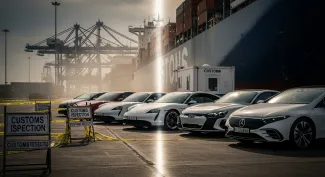
From 15% to 25%: The escalation explained
The new rate is not coming out of nowhere. Since the so-called Turnberry agreement of mid-2025, EU vehicles faced a 15 percent U.S. tariff — already a sharp jump from the historical 2.5 percent standard. Trump now claims the EU has failed to comply with that deal, justifying the hike to 25 percent, a level typically reserved for raw materials like steel and aluminium.
For European manufacturers, the math is brutal. According to ACEA, the EU’s automotive trade surplus stood at €76 billion in 2025, but overall export volume had already dropped 6.2 percent under the earlier tariff regime. A further spike to 25 percent could accelerate that decline dramatically.
Which brands get hit hardest
Germany is the most exposed. Producing roughly one in five vehicles sold in the EU, German premium brands — Volkswagen, BMW, Audi and Mercedes-Benz — rely on the U.S. as a core export market. ACEA data show that EU car exports to the U.S. fell 21.4 percent in 2025 year-on-year, and the new rate threatens to deepen the wound.
Industry analysts estimate that Volkswagen Group and Stellantis alone face annual tariff costs exceeding $5.9 billion. Audi is reportedly looking at a hit of around €1.2 billion, forcing the Ingolstadt brand to accelerate plans for U.S.-based production.
Mercedes-Benz has already begun shifting GLC assembly to its Alabama plant from 2027, a move that now looks prescient. Smaller European EV startups with no American manufacturing footprint — think Polestar or certain Renault derivatives — have far fewer options.
The EV angle: why electrification makes this worse
Here is what the headlines often miss: electric vehicles are particularly vulnerable to tariffs. Why? Because EV profit margins are already thinner than those of combustion models, and European EVs sold in the U.S. tend to be higher-spec, longer-range variants built in Europe — not locally.
Unlike Tesla, which manufactures the Model Y in Texas and California, or Hyundai, which is expanding its Georgia EV hub, most European brands still ship battery-electric crossovers and sedans across the Atlantic. The BMW iX, Mercedes EQS SUV and Audi Q8 e-tron are all produced in Germany. A 25 percent tariff either erodes margins or forces sticker-shock price hikes in a market where EV demand is already price-sensitive.
Compounding the problem, the U.S. EV tax credit landscape remains restrictive for imports. Many European EVs do not qualify for the $7,500 federal incentive, meaning the tariff hit lands on the full retail price — a double penalty that local American and Korean rivals do not face.
What the industry is not saying
Official statements from European CEOs have been cautious. Most cite "monitoring the situation." But behind closed doors, the strategy is shifting fast: regionalise or die.
Volkswagen Group has already concluded that its German-centric export model is unsustainable. The company is cutting one million units of European and Chinese capacity while openly exploring shared-plant deals — including with Chinese partners — to lower costs. Stellantis CEO Antonio Filosa is consolidating investment around Jeep, Ram, Peugeot and Fiat, while relegating Citroën, Opel and Alfa Romeo to regional roles.
The unspoken reality is that building a new U.S. EV factory costs $2–4 billion and takes three to five years. In an era of falling European EV market share — BEVs reached just 19.4 percent of EU sales in Q1 2026 — few boards have the appetite or the cash for such bets.
What happens next
The European Commission has not yet announced retaliatory measures, but history suggests they are coming. The risk is a tit-for-tat spiral that hurts consumers on both sides of the Atlantic. For European EV buyers, a trade war could delay the arrival of affordable American EV models and push European brands to prioritise profitable home markets over expansion.
For the U.S. market, the immediate effect is likely to be higher prices for European EVs and a smaller selection of imports. Longer term, if VW, BMW and Mercedes follow through on U.S. factory plans, the tariff shock could paradoxically help American EV manufacturing — at the expense of European jobs.
One thing is clear: the era of frictionless transatlantic car trade is over. For Europe’s electric transition, that is a costly headache it did not need.
When do the new 25% tariffs take effect?
President Trump said the tariffs would take effect as early as next week, which points to around 8 May 2026, though the exact implementation date may depend on U.S. customs procedures.
Does this affect only fully electric vehicles?
No. The 25% rate applies to all passenger cars and trucks imported from the EU, regardless of powertrain. However, EVs are disproportionately affected because they already have thinner profit margins and fewer local U.S. assembly options.
Could European brands simply move all EV production to the United States?
In theory, yes, but building a new EV plant costs billions and takes years. With European EV demand slowing and margins under pressure, most manufacturers are prioritising shared platforms and selective localisation rather than full-scale U.S. migration.
Source: https://www.autonews.com/news/an-trump-eu-auto-tariffs-25-percent-0501/