From Promise to Production Line
When Elon Musk first pulled the wraps off the Tesla Semi in November 2017, he promised deliveries would begin in 2019. That deadline came and went. It was not until October 2022 that a handful of hand-built pilot vehicles began trickling out of a small production line in Nevada, mostly serving Tesla's own logistics fleet and a modest 36-unit order from PepsiCo in California. Over the following three years, the company focused on refining the design, cutting roughly 450 kilograms from the cab, and constructing a purpose-built factory adjacent to Gigafactory Nevada in Sparks — a facility reportedly designed for an annual capacity of up to 50,000 trucks.
The wait appears to have yielded a genuinely competitive product. Tesla has confirmed two variants: a Standard Range version offering 523 kilometres of range at a gross vehicle weight of 37.2 tonnes, and a Long Range variant capable of 800 kilometres. Both use a powertrain with three integrated electric motors delivering up to 800 kW of power. Perhaps most striking is the pricing: $260,000 for the Standard Range and $290,000 for the Long Range. Industry analysts note this would make the Semi the most affordable Class 8 battery-electric tractor on the American market, undercutting established rivals from Daimler, Paccar, and Volvo by a significant margin.
Megawatt Charging: The Infrastructure Race
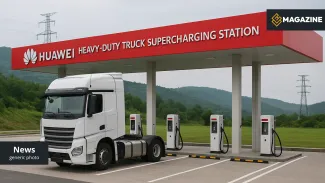
Raw range figures tell only half the story. The Semi is designed to support megawatt charging at 1.2 MW using Tesla's proprietary V4-based technology, which the company is now rolling out across the United States. The first Megacharger station is already operational in Ontario, California, with an additional 66 sites planned across 15 states. When scaled up, the system is expected to restore the majority of the 800-kilometre range in approximately 30 minutes — a critical benchmark for long-haul operators who cannot afford extended downtime.
For European observers, the charging infrastructure gap is particularly notable. While the EU has made strides with the Alternative Fuels Infrastructure Regulation (AFIR) mandating truck charging corridors, most public stations currently deliver 150–350 kW via CCS. The Megawatt Charging System (MCS) standard is still in its infancy on the continent, with only a handful of pilot installations. Tesla's aggressive build-out in the US suggests that infrastructure, not just vehicle technology, may become the decisive battlefield in the electric truck race.
Demand That Cannot Be Ignored
The market response in the United States has been extraordinary. Data from California's Clean Truck & Bus Voucher Incentive Project, a reliable barometer of commercial fleet intent, reveals that between January 2025 and February 2026, 965 of the 1,067 total applications submitted were for the Tesla Semi. Daimler, Paccar, and Volvo combined received fewer than 100 applications over the same period. This lopsided demand suggests that American fleet operators have been waiting for a compelling electric option — and that Tesla, despite its delays, has captured their imagination in a way legacy manufacturers have not.
Europe's Slower Lane
The contrast with Europe could hardly be starker. According to the European Automobile Manufacturers' Association (ACEA), electric truck registrations in the EU rose by 40 per cent in the first quarter of 2026, but the overall market share for rechargeable trucks over 3.5 tonnes reached just 4.4 per cent. In the heavy-duty segment above 16 tonnes — the direct equivalent of America's Class 8 market — the electric share was a mere 2.3 per cent. Germany led the pack with 497 heavy-duty electric trucks registered in Q1, yet even there, diesel still dominated with 92.4 per cent of all new truck registrations.
European manufacturers are not standing still. Volvo's FH Electric, Mercedes-Benz's eActros 600, MAN's eTGX, and Scania's battery-electric range all offer credible alternatives, many tailored to European regulations and cab-over design preferences that the Semi, with its long-nose American silhouette, does not satisfy. Moreover, Tesla has made no announcement regarding European homologation or a right-hand-drive version for the UK and Irish markets. The 800-kilometre range and aggressive US pricing, however, set a new benchmark that European engineers and product planners will struggle to ignore. If Tesla eventually brings the Semi across the Atlantic, or if its technology filters down into a cab-over variant, the competitive pressure on Europe's truck makers will intensify dramatically.
Will the Tesla Semi be sold in Europe?
Tesla has not announced European homologation plans for the Semi. The current design features a long-nose cab optimised for US regulations and aerodynamics, whereas European markets strongly prefer cab-over trucks for maneuverability in tighter spaces. Any European launch would likely require significant design changes.
How does the Tesla Semi's range compare to European electric trucks?
The Semi Long Range offers approximately 800 kilometres, which is competitive with or slightly ahead of current European heavy-duty electric trucks like the Mercedes eActros 600. However, real-world range varies significantly based on payload, terrain, and weather conditions.
What is megawatt charging, and when will it arrive in Europe?
Megawatt charging delivers power at 1 MW or higher, enabling heavy-duty electric trucks to recharge in roughly 30 minutes. The Megawatt Charging System (MCS) standard is being developed for European deployment, but widespread infrastructure is still several years away, with most current European truck stations limited to 150–350 kW.
Source: https://www.electrive.com/2026/04/30/tesla-unveils-its-first-mass-produced-electric-truck/