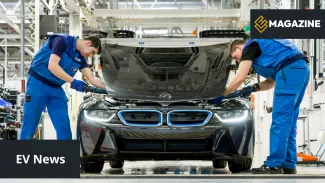
The electric vehicle market is no longer just about presence; it is about performance and endurance. For BMW, the upcoming 2027 iX3 represents a critical step in its transition toward a fully electric lineup. Recent reports indicate that the vehicle will receive a notable range boost of 34 miles (approximately 55 km), a move designed to make the SUV more viable for the long-distance driving patterns typical of the United States.
Addressing the US Market: Why Range Matters
While electric vehicle adoption has seen steady growth in Europe, the United States presents a unique set of challenges and opportunities. American drivers often traverse much larger distances between urban centers, making the "range anxiety" phenomenon more acute than in the more densely populated European markets. By boosting the iX3's range, BMW is not just updating a specification; they are adapting their product to the specific cultural and geographical needs of the American consumer.
The announced increase suggests that BMW has found significant efficiencies in either battery management, motor optimization, or aerodynamic refinement. For a premium SUV like the iX3, which balances luxury with utility, every additional mile of range translates to greater consumer confidence and a more competitive edge against established players.
The Competitive Landscape: Tesla and Audi
The premium electric SUV segment is one of the most contested arenas in the automotive world. The BMW iX3 will find itself in direct competition with the Tesla Model Y, which currently dominates much of the US market due to its integrated charging network and high efficiency. To compete, BMW must offer a driving experience that feels more "premium" while matching or exceeding the practical utility of Tesla's offerings.
Furthermore, the iX3 will face pressure from the Audi Q4 e-tron and other offerings from the Volkswagen Group. While Audi has focused heavily on build quality and sophisticated software, BMW's decision to prioritize range expansion ahead of its US launch shows a tactical understanding of where the market is heading. As battery technology matures, the "spec war" will increasingly focus on the balance between charging speed and total distance per charge.
Technical Efficiency and Battery Management
While specific technical details regarding the battery chemistry have not been fully disclosed, the range increase is likely the result of BMW's fifth-generation eDrive technology. This system focuses on maximizing the energy density of the cells and improving the efficiency of the power electronics.
In practical terms, an increase of 34 miles can be the difference between needing a charging stop during a mid-range trip or reaching a destination comfortably. This is particularly important as the US charging infrastructure continues to evolve, with many drivers still relying on a mix of CCS and the emerging NACS (North American Charging Standard) networks. A higher range provides a much-needed buffer during periods of high-speed highway driving, where energy consumption typically spikes.
What This Means for European Drivers
Although this specific news focuses on the US debut, European customers—who have been driving versions of the iX3 for some time—should take note. BMW's global engineering efforts often result in trickle-down benefits. It is highly probable that future iterations of the iX3 available in Europe will benefit from the same efficiency gains and software optimizations developed for the US market.
In Europe, where the charging network is more dense and driving distances are generally shorter, the focus remains on charging speed and urban efficiency. However, as European manufacturers move toward more standardized platforms, the technological leaps made for one major market almost always influence the global product roadmap.
As we look toward 2027, the iX3 stands as a testament to BMW's ability to iterate and improve. The brand is clearly listening to the market, recognizing that for an electric SUV to succeed in the premium segment, it must offer both the prestige of the BMW badge and the practical reliability of a long-range electric powertrain.
When will the updated BMW iX3 be available for purchase in the US?
The updated model is expected to debut as a 2027 model year vehicle, with availability likely starting in late 2026 or early 2027.
Does the range increase come at the cost of a higher price?
While BMW has not officially released the pricing for the US debut, range increases often involve higher-density battery cells or software optimizations that can influence the final MSRP, though BMW typically aims to remain competitive within the premium segment.
Will the iX3 support Tesla's NACS charging standard in the US?
While not explicitly confirmed in this specific update, most major manufacturers are currently transitioning toward NACS compatibility to ensure seamless access to the Tesla Supercharger network in North America.