
Five counties, 515 ports
The money covers Bucks, Chester, Delaware, Montgomery and Philadelphia counties. PennDOT expects the round to lift the number of publicly accessible chargers in the region by 27 per cent. In Philadelphia itself the increase could reach 53 per cent.
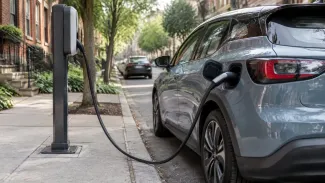
The installations are a mix. Some are on-street Level 2 posts on residential blocks, some are DC fast-charging bays at shopping centres, car parks and retail sites. That mix matters more than the headline number: a driver without a driveway needs a slow post near the front door overnight, while a driver passing through needs a fast one for twenty minutes.
Who received the grants
Charging provider It's Electric PA received $2.93 million to install 157 on-street Level 2 charging ports in 13 Philadelphia neighbourhoods. Voltpost secured funding for on-street installations in Bucks, Chester, Delaware and Montgomery counties.
The largest single award went to Positive Energy: $7.22 million for 54 fast-charging ports at 11 Philadelphia Parking Authority car parks. PNE Solutions America was awarded $4.47 million for 24 ports across five locations, and Wawa received funding for installations in several counties.
"The Shapiro Administration hit the ground running with EV funding and the results speak for themselves," said PennDOT Secretary Mike Carroll. "Under the Governor's leadership, Delaware Valley residents and travelers will soon have access to more than 500 new EV chargers in their communities."
What a charging port costs
Divide the money by the ports and the average grant works out at about $71,800 per port across the whole round. That average hides a wide spread, and the spread is the interesting part.
It's Electric PA's on-street round comes to roughly $18,700 per Level 2 port. Positive Energy's fast-charging project works out at about $133,700 per DC port. PNE Solutions America lands near $186,250 per port. A DC cabinet needs a bigger grid connection, a transformer and civil works that a kerbside post does not, and the per-port figures reflect that.
One caveat: these are grant awards, not total project costs. Recipients normally co-fund the construction, so the real cost per port is higher than the numbers above. Treat them as a floor.
Where Pennsylvania stands so far
PennDOT says the state now has 54 operational stations built with NEVI funding, with another 34 planned or under construction. Since the first NEVI-funded station opened in December 2023, the network has recorded more than 183,000 charging sessions and is estimated to have avoided around 4,600 tonnes of CO2.
The community charging round is backed by more than $100 million in federal funds. A separate $58 million has already gone to stations along designated alternative fuel corridors and connecting routes. NEVI itself is the federal charging programme created by the 2021 infrastructure law.
Why on-street charging matters
Philadelphia has a lot of rowhouses and a lot of renters. For those households, the economics of an electric car depend entirely on what is available at the kerb. Home charging is the cheapest way to run an EV; public DC charging is the most expensive. Our charging cost calculator lets you put your own tariff and consumption into that comparison.
A Level 2 post typically adds 30 to 50 km of range per hour, depending on the car. A car parked overnight on a residential street can therefore leave in the morning with a full battery, at a fraction of the cost of a fast-charging stop.
The European comparison
Funding for this kind of charging is being debated in Europe too, at a different scale. The UK government has set aside £100 million for cheaper low-powered charging from spring 2027, a pot more than twice the size of this Pennsylvania round even before the exchange rate is applied.
Our own supercharger database covers 483 locations across Europe. Note the unit difference: those are locations, each with several stalls, while Pennsylvania's 515 figure counts individual ports. Comparing the two numbers directly would flatter the American side of the ledger.
What remains open
The awards cover five counties out of Pennsylvania's 67, all in the south-east around Philadelphia. Whether the same approach – small grants for kerbside posts, larger ones for car-park fast chargers – gets repeated in the rest of the state is not part of this announcement.
What is on the record: 54 NEVI stations open, 34 planned or under construction, and 515 more ports funded but not yet built. Installation dates for the new round have not been published.