
The £100 million and who it targets
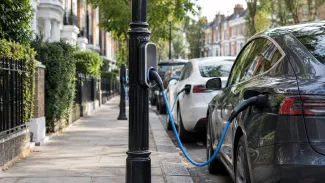
The money was announced in the 2026 Autumn Budget and will be spread over two years from spring 2027. It is aimed at lower-powered AC chargers of the kind bolted to lampposts and installed in pavements on residential streets, where a car can stand for several hours or overnight. The Treasury says the focus is on drivers without off-street parking, and that it expects them to save around £150 a year.
That is roughly €115 million at recent exchange rates. What the government has not said is how the money reaches the price on the charger. It could subsidise charge point operators, reimburse them for discounts, or work some other way. The mechanism is still open.
What the charging review found
The pledge follows an independent review of public charging costs launched under the 2025 Budget. It found that prices at lower-powered AC chargers had risen by 69% in real terms since 2021. Prices at high-powered DC chargers, the kind at motorway services, rose by 94% over the same period.
The review suggested tariff porting, alongside other measures, could cut local public charging costs by 15–20p per kWh. That range is the number worth holding on to, because it lets you check the £150 figure against your own driving.
What £150 a year assumes
Do the arithmetic. At a 20p per kWh reduction, £150 buys 750 kWh. At 15p, it buys 1,000 kWh. In a family car using about 3.5 miles per kWh, that is somewhere between 2,600 and 3,500 miles charged on the street each year.
For a European family covering 1,000 km a month in an EV that takes 18 kWh per 100 km, the annual draw is about 2,160 kWh. If the full 15–20p reduction reached every one of those kWh, the saving would come to £324 to £432 a year. That is the ceiling, not the promise. The £100 million is finite, it is spread over two years, and it is aimed at lower-powered chargers, not the fast ones you use on a holiday trip.
Our charging cost calculator lets you put your own consumption and local rates in and see the difference between charging at home and charging on the street.
VAT stays at 20%
The Budget stopped short of cutting VAT on public charging. It remains at 20%, while domestic electricity is usually taxed at 5% and has been temporarily reduced to zero from October 2026. The Budget instead proposes legislation to clarify the 20% treatment of publicly accessible and workplace charging from 1 November 2026.
The charging industry has asked successive UK governments to close that gap, arguing it penalises drivers without driveways. For the moment the gap stays, and the temporary zero rate on home electricity makes it wider than usual.
Gullies, and the taskforce on tariff porting
Earlier in October, new rules came into force in England allowing eligible cross-pavement charging channels, known as gullies, to be installed without planning permission. The government says that could save households up to £300. The point of a gully is to let a car parked at the kerb draw from the house supply at domestic rates.
A separate industry-led taskforce will look at tariff porting, a system that would let a driver use their domestic electricity tariff at certain public charge points. The Department for Transport is expected to publish further details. Which charge points, which suppliers and which tariffs is not settled.
The build-out of public charging is moving in the background. We reported in September on Ionity fitting battery storage at 50 of its charging parks, and on the Xpeng L03 and its 236 kW DC peak. Faster hardware does not fix the price of an overnight top-up on your own street.
What to check before you count on street charging
If you are weighing up an EV without a driveway, start with your own council. Lamppost charging is installed council by council, and the per kWh price varies by operator and by area. The rate shown in the network app before you plug in is the rate you pay.
Compare that rate with what a home tariff would cost you, then with the price at a rapid charger for the two or three long trips you make each year. Our EV tariff calculator and the list of cheapest fast charging locations cover both ends of that comparison.
The £100 million starts flowing in spring 2027. Until the government sets out how it will be delivered, no driver can say what their street charger will cost that year.
Source: https://www.electrive.com/2026/10/29/uk-government-pledges-100m-to-cut-public-ev-charging-costs/