
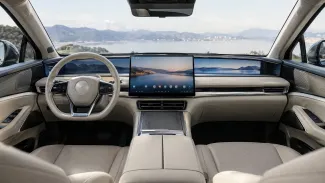
Four colours and a 30-inch screen
The colourways are Moon over Empty Mountain, which pairs light beige with deep blue; Morning Mist Beige in a single tone; Dawn Red with warm reddish upholstery; and Evening Plain Brown in dark brown. Denza also confirmed wood trim, concealed air-conditioning vents and a floating centre console with a 64-facet crystal drive selector. Speakers and seat adjustment controls sit together in the door panels.
The dashboard carries the two displays Denza showed in August: a 1.1-metre panoramic head-up strip and a 30-inch central touchscreen. That is a lot of glass and screen for a five-seat family SUV, and it raises the usual question about how much of the 1.1 metres is actually readable from the driver's seat.
Five seats in a 5.15-metre body
The N8 measures 5,150 mm long, 1,999 mm wide and 1,820 mm tall, with a 3,075 mm wheelbase. It has two rows and five seats. The related N8L is 5,200 mm long with six seats but shares the same wheelbase, so the extra 50 mm buys the third row.
For a family car, 5.15 metres is worth flagging. That is longer than a Skoda Kodiaq by roughly 400 mm, and it carries two rows. Parking garages in Prague or Vienna were not designed around it.
The 1,003 km figure, converted
Denza quotes 1,003 km on the CLTC cycle. Using the 0.82 conversion factor we apply elsewhere, that is about 822 km WLTP. Divide the 130.15 kWh pack by those numbers and the consumption comes out at 12.97 kWh/100 km on CLTC, or 15.8 kWh/100 km at the WLTP-equivalent figure.
The second number is plausible for a car this size; the first is not. That gap is the honest summary of CLTC. If you want to see how far official figures tend to drift from measured ones, our range calculator lets you plug in your own consumption instead of the brochure value.
A smaller 105.792 kWh pack is also listed in Chinese regulatory filings. Denza has not published a range figure for it. Single-motor rear-wheel drive and tri-motor all-wheel drive versions appear in the filings, with the flagship AWD using the e3 system: one front motor, two at the rear, 890 kW (1,193 hp) combined.
Five minutes to 70% means 937 kW
Denza advertises 10–70% in five minutes on the 130.15 kWh battery. That is 78.1 kWh delivered in 300 seconds, an average of 937 kW. The 10–97% claim of nine minutes works out to about 113 kWh and 755 kW average. Neither is achievable on a 350 kW or 400 kW charger, whatever the car can accept.
This is the part European readers should read carefully. Our supercharger database tracks 483 locations across Europe, and the hardware on most of them is nowhere near the megawatt class. Megawatt charging does exist on this continent: Milence opened a truck hub in Belgium with 1.5 MW chargers, but those posts are built for lorries, not for a five-seat SUV. Denza also says the charge takes three minutes longer at −30°C, which is a claim we cannot check until someone runs it in a Scandinavian winter.
The running costs follow from the consumption. At 15.8 kWh/100 km and €0.60/kWh on a public fast charger, that is €9.48 per 100 km. At a home tariff of €0.25/kWh it drops to €3.95. Our charging cost calculator does the same arithmetic with your own tariff.
Where it sits against Chinese rivals
Range claims in this segment are drifting upward faster than measured results. We covered the Li Auto i6 completing 811 km on a single charge in an urban test, which is a measured loop rather than a homologation figure. The N8's 1,003 km is a CLTC number. The two are not comparable, and Denza has not published an independent measurement.
The N8 also has to live next to its own sibling. The N8L launched in September with a 130 kWh battery and a 960 km CLTC claim, so the five-seat N8 gains roughly 43 km of claimed range on the same wheelbase by carrying one row fewer.
No price yet
Blind reservations open in China on 26 October. The official market launch is scheduled for November, when Denza is expected to announce pricing and delivery details. No European availability or pricing for the N8 has been announced.
Until the price is published, the only firm numbers are the dimensions, the two battery options and the charging claims, and one of those three is arithmetic that depends on chargers most buyers will never see.