
Tesla's quarter: margins up, profit down
Tesla reported Q3 2026 results with margins rebounding and profit still falling. The company blamed battery supply for flat sales, while prices keep falling. Those two statements sit awkwardly together, and the price trend is the more informative of the pair. Energy revenue dropped 16% in the same quarter, after Tesla refunded customers over tariffs.
Capex guidance for 2026 was quietly cut to $20 billion. Keep that figure in mind whenever the same call promises a robotaxi fleet, a humanoid production line and unsupervised self-driving software in the same breath. Capital plans and product plans rarely move in opposite directions by accident.
Two dates have moved
Unsupervised FSD now points to Q2 2027, restricted to robotaxi zones. Electrek's roundup notes that full autonomy has been roughly six months away for about nine years running. Optimus deliveries moved to late 2027, with the company saying the hands remain a problem.
Neither slip changes a single car you can order in Europe today. It changes how much weight a timeline from any manufacturer deserves.
What 460 kW means at the charger
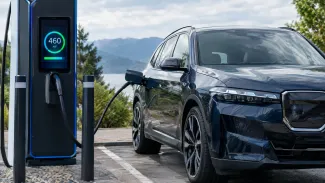
BMW's iX5 reached 460 kW during its first public fast-charging demonstration. A peak figure makes a good headline, so here is the arithmetic that matters. A 100 kWh pack charged from 10 to 80% takes on 70 kWh. At a constant 460 kW that is 9.1 minutes. At 350 kW, the rating of Tesla's V4 stalls and of the 24-stall Electrify America hub we covered earlier this month, the same 70 kWh takes 12 minutes.
Real packs taper. If average power across the window lands at 60% of peak, the 460 kW car needs 15.3 minutes and the 350 kW car 20 minutes. A gap of about five minutes. Useful on a 900 km day, irrelevant on the school run.
Cell chemistry sets the ceiling on all of it. Fraunhofer ISE's silicon anode cell, which we wrote about here, reached 1,000 cycles at 83% capacity and 280 Wh/kg. High-power charging is exactly what stresses that cycle life.
Porsche's inductive pad reaches production
Porsche has put wireless charging into production. The system is rated at 11 kW. In a car using 18 kWh/100 km, one hour on the pad delivers roughly 60 km of range before transfer losses, so count on 50 to 55 km in practice. That is home-charging territory, not road-trip territory.
For a driver who parks in the same bay every night, 11 kW without a cable is a genuine convenience. It does not shorten a single journey, and it does not help anyone living in a flat without a private parking space.
Six megawatts, a robot and a heavy cable
Fortescue is using KUKA welding robots to handle 6 MW charging cables. The reason is physical. A cable carrying megawatt current is thick, heavy and liquid-cooled. A 600 kWh truck pack charged from 10 to 80% absorbs 420 kWh. At an average 1 MW that is 25 minutes; at a 6 MW peak the same window falls to 4.2 minutes, if cells and cable both allow it. For freight, those minutes decide whether a schedule fits inside a driver's legal break.
Cost per 100 km, our calculation
Our supercharger database tracks prices at 483 locations across Europe, and the spread between them matters more than any peak power figure. Take a large electric SUV at 20 kWh/100 km. Home charging at €0.25/kWh costs €5.00 per 100 km. DC fast charging at €0.59/kWh costs €11.80. A petrol SUV at 7.5 l/100 km and €1.50/l costs €11.25.
On public charging alone, the electric car is level with the petrol one. That is the honest result, and it is why home charging, not charger wattage, does most of the work in the total cost of ownership. Run your own tariff through our charging cost calculator, and check the cheapest sites in the database on this page.
What is still missing
BMW has published a peak from one demo session and no full 10–80% curve. Porsche's 11 kW pad serves one kind of parking. Fortescue's 6 MW cable needs a robot to lift it. Three partial answers, and the number that decides whether a car is genuinely fast on a long trip, the average power between 10 and 80%, is still unpublished. As of 24 October 2026, that is the figure we are waiting for.