
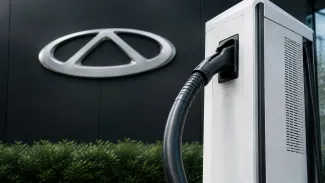
Six minutes and fifty seconds. That is the time Chery says its new Volt-Dragon charger needs to take a passenger car from 10 to 97 per cent. The Chinese carmaker showed the system at its Global Innovation Conference this week, with a peak output of 1.44 MW. No Chery model on sale in Europe can accept that today, and the company has not named the cars that will.
What Chery presented
Chery is the fourth Chinese manufacturer to put a megawatt-class charger on stage, after BYD, Huawei and Geely. The Volt-Dragon unit is quoted at 1.44 MW peak and a 10 to 97 per cent window of 6 minutes 50 seconds. Chery says the system will later support a robotic arm for automatic connection and vehicle-to-grid feedback. The rollout begins in China. The first stations, described as 100 MW installations, are planned for ten cities, with detailed expansion plans promised before the end of 2026. By 2029 the company wants more than 20,000 V2G-capable Volt-Dragon stations worldwide. What Chery did not present was a car. No compatible model was named. Car News China reports only that the vehicles will probably use 800 V or 1,000 V architectures.What 1.44 MW means in numbers
Peak figures are easy to print and hard to interpret. A few conversions help. At 1,000 V, 1.44 MW means 1,440 A through the cable. That is why these systems use liquid-cooled leads. If the charger held its peak for the whole 410 seconds of Chery's window, it would push about 164 kWh into the car. The actual claim, 10 to 97 per cent, is roughly 87 kWh on a battery of around 100 kWh. That averages about 760 kW, so the advertised peak is close to double the average. A 350 kW charger would need around 15 minutes at full power for the same 87 kWh, a 150 kW unit about 35 minutes. Real cars taper, so treat these as bookkeeping, not promises. For scale, 1.44 MW is roughly 83 Czech households drawing a standard 3×25 A connection at the same moment. For a family with small children, seven minutes is also shorter than the stop itself usually takes.The competition in China
BYD quotes 6 minutes 27 seconds for 10 to 98 per cent. Huawei and Geely give 8 to 9 minutes. Chery's marketing line, as reported by Car News China, is 500 km in five minutes. Station counts separate the companies more than the stopwatch. BYD said at the end of August that it had installed 10,000 Flash Charging stations and wants 20,000 by the end of 2026. Chery's 20,000 target is dated 2029 and covers V2G-capable sites worldwide, not only megawatt ones.What is missing
No independent test, no published charging curve, no named vehicle. The 6:50 figure comes from the manufacturer and nobody outside Chery has repeated it. Battery life is the open question with any very high-power charging. Pushing an average of 760 kW into a pack for seven minutes puts a lot of heat through the cells, and they have to survive several hundred such sessions. Work on more tolerant chemistries continues. Fraunhofer ISE reported a silicon anode cell that held 83 per cent of its capacity after 1,000 cycles at 280 Wh/kg. It is a lab result, not a production car, but it shows where the constraint sits. Grid connections are the other limit. Electrify America's 24-stall, 350 kW hub near Orlando is what a large site looks like in the West today. A single 1.44 MW cabinet draws more than four of those stalls combined.European charging rules
Chery sells cars in Europe under the Omoda and Jaecoo brands but has announced no megawatt charging for this market. The EU's AFIR rules set the current benchmark: charging pools every 60 km on the TEN-T core network, with at least 400 kW total and one 150 kW point by the end of 2025, rising to 600 kW with two 350 kW points by the end of 2027. Closing that gap needs grid connections, a common standard and cars able to accept the power.What this means if you are buying now
Megawatt charging is no reason to delay a purchase. What matters is the peak DC power the car itself accepts and how long it holds it. A model that takes 150 kW flat will beat one that spikes to 250 kW for ninety seconds and then drops. Run the numbers first. Our charging cost calculator shows what a realistic mix of home and public charging costs per year, and the charging station map shows what sits along your usual routes. Chery has promised more detail on the Volt-Dragon rollout before the end of 2026. Until a compatible car is on the road and someone independent has timed it, the 6 minutes 50 seconds remains a figure from a stage.Source: https://www.electrive.com/2026/10/23/chery-launches-megawatt-charging-system-for-passenger-evs/