
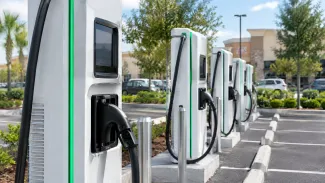
What opened in Orlando
Electrify America opened the site on 22 October 2026 at the Sand Lake Corners South shopping centre in Orlando, Florida. It has 24 DC fast chargers, all with CCS connectors, rated at up to 350 kW each. The location sits close to Interstate 4 and Orlando International Airport, and it is aimed at both local drivers and visitors heading to the theme parks.
According to electrive.com, Electrify America already runs more than 350 chargers at over 60 sites in Florida. The company says Florida had the second-highest number of registered electric cars in the US in 2025, after California. A further ten-charger site is due to open in Orlando in the coming months.
Twenty-four bays add up to 8.4 MW
Multiply the posts by their rating and the site's nameplate power is 24 × 350 kW, or 8.4 MW. No electric car holds 350 kW for long, which is why the headline figure flatters every fast-charging site. Electrify America's 20-bay station in Santa Barbara, California, opened in June with a 1.9 MW battery on site. That works out at roughly 95 kW of buffer per bay, and it tells you more about real load than the 350 kW stickers do.
For a driver, the useful measure is how many cars can plug in at once. On that count the Orlando site is a different size of thing from most of what surrounds it. Florida's 350-plus chargers spread across 60-plus locations average fewer than six posts per site.
Sessions per charger across the network
Electrify America says it passed 5,600 chargers across North America in 2025, with more than 20 million charging sessions that year. Divided out, that is about 3,570 sessions per charger per year, or roughly ten a day per post. A site with 24 posts can absorb a busy afternoon that a four-post site cannot.
What a family stop actually needs
Anyone who has driven to a holiday park with children knows the shape of the stop. You arrive with a low battery, everyone needs a toilet, and the youngest needs to eat before the car is ready. Twenty-four posts mean a broken charger, or four broken chargers, does not end the afternoon. It also means you are less likely to be the fourth car waiting while a driver ahead charges to 100% because there is nowhere else to go.
The shops and restaurants at Sand Lake Corners matter as much as the electronics. A 10–80% top-up on a 77 kWh battery is about 54 kWh. At an average 100 kW over the session, that is roughly half an hour, and the children will still be eating when the car is done. You can put your own trip numbers into our charging cost calculator and our range calculator before you set off.
CCS only, for now
The Orlando site offers CCS connectors only. Electrify America widened a pilot programme for NACS plugs at selected high-traffic sites in July 2026, but this one opened without them. Drivers of cars with native NACS ports need an adapter here, and drivers of CCS cars in Europe are unaffected by that particular wrinkle, since CCS2 is the standard plug on this side of the Atlantic.
The European yardstick
EU rules for the core TEN-T network ask for charging pools of at least 400 kW roughly every 60 km. The Orlando site's 8.4 MW nameplate is about twenty times that minimum, at one address. That is not a like-for-like comparison, because European corridors are built for coverage over distance while this site is built for a dense queue of holiday traffic, but it shows how much capacity a single urban location can now carry. If you are planning a European trip instead, our Supercharger database of 483 locations and the charging station map are the places to start, and the cheapest sites list is worth a look before a long drive.
Capacity planning is not only an American question. We covered the Source network opening its UK ultra-rapid hubs to GreenFlux roaming, and the British rule change that lets households run a charging cable across the pavement and save up to £300. Both are about removing the small obstacles that decide whether a charging stop is a chore.
What to check before you rely on a site like this
Check live availability in the operator's app before you leave the motorway, not when you arrive. Have a second site in mind, because a 24-post hub is still one address and a road closure or a full car park can take it off the table. Do not plan a long detour around a single stall. And be honest about your car's charging curve: a car that peaks at 100 kW will not go faster because the post says 350.
Will my car charge at 350 kW at this site?
Only if the car itself accepts that power. The post sets a ceiling, not a promise. Most family EVs peak well below 350 kW and slow down noticeably above 80% state of charge.
Do I need an adapter at the Orlando site?
If your car has a native NACS port, yes, because this location opened with CCS connectors only. Electrify America is running a separate NACS pilot at other high-traffic sites.