Reviews & Tests

BYD Danza D9 and Z9 GT: 115 kWh, 850 kW, and 100 Flash Chargers for Indonesia

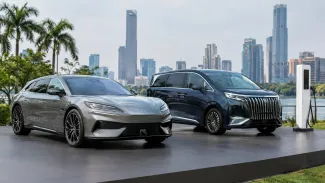
The Denza Z9 GT shooting brake and the updated Denza D9 MPV on a stage in Jakarta, with a white BYD Flash Charger unit standing beside them. AI-generated illustration.
BYD has begun selling cars in Indonesia under the name Danza, after a trademark dispute forced it to drop Denza locally. The first two models are the updated D9 MPV at IDR 1.08 billion, about €53,200 on the road in Jakarta, and the Z9 GT shooting brake at IDR 2.25 billion, roughly €110,800. Both come only as battery-electric cars there, both use the second-generation Blade LFP battery, and BYD says it will have 100 Flash Chargers installed in the country by December.

Two cars, two price points

ModelBatteryDriveNEDC rangePrice, Jakarta on-road
Danza D9115 kWh340 kW, front motor730 kmIDR 1.08 bn / €53,200
Danza Z9 GT122.49 kWh850 kW, three motors, 1,210 Nm701 kmIDR 2.25 bn / €110,800
The D9 is the interesting one for families. Its pack grew from 103.36 kWh to 115 kWh, an 11 % increase, and the front motor went from 230 kW to 340 kW. NEDC range rose by 110 km to 730 km. The Z9 GT is a different animal: 850 kW and a claimed 0–100 km/h in 2.7 seconds, with 122.49 kWh on board. Both figures are manufacturer claims. There is no independent real-world measurement of either car yet, and that is the number we would want before writing anything definitive. When such data appears, the Bjørn Nyland range calculator is where we will put it.

The charge curve in kW

BYD demonstrated the D9 in Jakarta. From 10 % to 70 % state of charge took 5 minutes 48 seconds. Continuing to 97 % took 9 minutes 43 seconds in total. Convert that. Sixty percent of 115 kWh is 69 kWh, delivered in 0.0967 hours, which works out to 714 kW average. The full 10–97 % window moves 100.05 kWh in 0.1619 hours, or 618 kW average, about 5.4C for the pack. BYD quotes up to 1,500 kW for the charger itself, and each T-shaped unit carries two dispensers. A single car therefore cannot take the whole 1,500 kW. The 618 kW average is the figure a driver actually experiences, and it is still far above anything on sale in Europe today. The charging peak of the D9 is not published. An average of 618 kW implies a peak well over 700 kW, but we would rather see the curve than do arithmetic on a press release.

NEDC range against expected consumption

NEDC is a generous cycle, and the implied consumption shows it. A 115 kWh pack covering 730 km means 15.8 kWh/100 km. For the Z9 GT, 122.49 kWh over 701 km means 17.5 kWh/100 km. A large electric MPV does not use 15.8 kWh/100 km at motorway speed. Figure on 24 to 28 kWh/100 km in mixed driving and 30 kWh/100 km at a steady 130 km/h. With roughly 110 kWh usable, that is about 420 km in mixed use and closer to 360 km at motorway pace. Fine for Java, where the island is 1,000 km long end to end, less fine for a Prague to Munich run in January. You can run your own assumptions in the range calculator.

Cost per 100 km

Divide price by claimed range and the D9 comes out at €72.9 per kilometre of NEDC range. The Z9 GT lands at €158.1. That metric flatters long-range cars, but it is a quick way to see how much of the sticker price buys battery. For running costs, take a consumption of 26 kWh/100 km. Charged at home at €0.20/kWh, 100 km costs €5.20. Charged on a European DC hub at €0.50/kWh it costs €13.00, which is roughly what a diesel van at 7.5 l/100 km and €1.60/l burns. Home charging is where the saving lives; public charging is not. Our charging cost calculator handles your own tariff.

One hundred chargers by December

The first ten Flash Chargers go to Danza dealerships. Unit number one is already running at the Danza Bipo Gatot Subroto site in Jakarta. Richard Li, BYD's Flash Charging director for Asia Pacific, set the target of 100 locations by the end of the year. Drivers will find them through the apps of Utomo Charge+, iGreen+ and Arista Power, plus a dedicated BYD Flash Charging app. Our own supercharger database tracks 483 European locations with prices; Indonesia is not in it yet. BYD is not alone in pushing this class of charging. Li Auto presented its own 5C cell and the updated i6 on 20 October, as we reported in our coverage of Li Auto Power Day.

Why 1,500 kW is rare in Europe

Current is the constraint. A 1,000 V pack drawing 1,500 kW needs 1,500 A through the cable and connector. European public hubs commonly deliver 350 to 400 kW per dispenser, and the grid connection behind a site is usually the binding limit before the hardware is. Southeast Asia is where Chinese makers are installing this equipment first. Nio opened a 350 m² Firefly store in Bangkok this year, a story we covered in Nio's Thai retail push. BYD's Indonesian announcement does not include a European price, a European launch date, or a plan to ship Flash Chargers to EU markets. The D9 and Z9 GT are listed in our EV catalog as soon as specifications become available for European versions. For Indonesia, the concrete fact is the first charger at Gatot Subroto and a target of 100 units by December.

Source: https://www.electrive.com/2026/10/20/indonesia-byd-launches-first-danza-evs-prepares-to-deploy-100-flash-chargers/

Discussion

No comments yet — be the first to share your thoughts.