
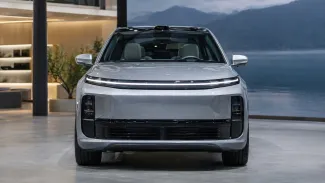
Li Auto holds its Power Day on Tuesday, October 20, at 19:30 Beijing time (13:30 CEST), eight days before the updated Li i6 goes on sale in China on October 28. The company has confirmed an in-house 5C battery and the Mach assisted-driving chip for the car. It has not published a peak charging power, a charge curve or a real-world consumption figure. That is what the event is expected to fill in, and it arrives while Li Auto's September deliveries stood at 31,817 vehicles, down 6.29% year on year.
What Li Auto has confirmed
Li Xiang, the company's founder and CEO, wrote on Weibo on Monday that the decision to develop batteries in-house was taken in 2020, and that existing cell suppliers remain partners. He reached for the personal computer industry as an analogy: integrated hardware development and specialist chip suppliers can both improve the product. "There is only 1 criterion: which approach is better for users," he wrote. The cells are already in production cars. Li Auto said on September 7 that in-house batteries are used in the Li L8, L6 and i8, with plans to extend them across the lineup. Manufacturing runs through a 50/50 joint venture with Sunwoda established in 2025. The scope covers cells, packs, battery management, thermal management and electric drive, plus the Lianshan monitoring system, which links data from upstream materials through cell and pack production to the car in use so that individual cells can be traced. The updated i6 adds the Mach assisted-driving chip on top of the 5C pack.What 5C means in numbers
C-rate is capacity per hour. A 5C cell can in theory be charged at five times its capacity, so a 75 kWh pack would pull 375 kW. Going from 20% to 80% means moving 45 kWh of energy; at a flat 375 kW that takes 7.2 minutes. No production pack holds a flat rate. Cells taper as they fill, the pack's thermal management sets the ceiling, and the charger has to supply the power in the first place. A 5C label describes a cell's capability, not the session a driver will get on a wet Tuesday. Li Auto has not yet said what peak power the i6 will request or how long the curve stays high, and those two numbers decide whether the badge means anything at a public stall. The European comparison is blunt. Our supercharger database tracks 483 locations across Europe; stalls that can deliver 350 kW or more to a car that actually accepts it are still a minority of the network. Fast charging economics also weigh more than the C-rate. Charging that 45 kWh window costs roughly €11 at €0.25/kWh at home and about €27 at €0.60/kWh on a public fast charger. You can run your own figures in our charging cost calculator. BYD is the reference point Chinese buyers will use. Its flash-charging platform, shown in March 2025, claims 1,000 kW peak and a 10C rate on its newest LFP cells. Li Auto's 5C sits below that claim on paper. Whether it delivers a flatter curve is a separate question, and one Power Day could answer.Deliveries and the pressure behind the event
September brought 31,817 deliveries, 6.29% fewer than a year earlier. Working back from that percentage, September 2025 was about 33,950 vehicles. The first nine months of 2026 total 293,436, down 1.25%, which puts the 2025 figure near 297,150. Li Auto is roughly 3,700 vehicles behind its own pace from last year. Context matters here. Europe set a September sales record while North America dropped 44%, as we reported in our analysis of September registrations. Different segments, different incentive schemes, so the two figures should not be read as one trend. Still, a Chinese maker heading into a product launch with a small annual decline has reason to put technology, not volume, at the centre of the presentation.The supplier question
Li Xiang thanked CATL on September 28 for its work on batteries for the Li One and Li Mega, and said the in-house strategy is not defined by cutting suppliers out. The timing was not accidental. China's auto industry has spent the autumn arguing about how work should be split between carmakers and battery manufacturers. CNII, a media outlet affiliated with the Ministry of Industry and Information Technology, commented on September 22 that adding suppliers and developing in-house are ordinary market activity and should not be framed as a confrontation between the two sides. Li Auto's messaging follows that line: in-house where it pays off, partners where they do better. Solid-state cells sit further out. A September report on Li Auto's solid-state timeline pointed to limited vehicle use in 2027 or 2028, with prototypes already validated.What is still missing
Li Auto has not disclosed which technologies or performance metrics Power Day will cover. The 5C pack, the Mach chip and the Lianshan traceability system are the pieces already public. The i6 launch follows on October 28, with deliveries in China from early November. The i6 is a China-market model; no European launch has been announced. For anyone comparing cars on paper, our EV catalog holds full specifications for 67 models sold in Europe, and the range calculator will show what a WLTP figure turns into at motorway speed. That gap between the badge and the session is the same gap Li Auto has to close on October 20. Charging networks are expanding meanwhile: Fastned reported Q3 charging revenue of €46.3 million, up 47%, with 65 stations under construction.Source: https://cnevpost.com/2026/10/19/li-auto-power-day-oct-20/