
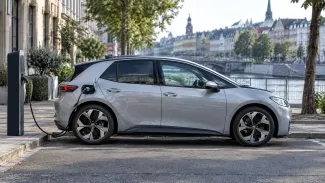
A record September in Europe
Europe's September total beat its previous record, set in June, by 10%. Battery electric cars did most of the work. Their sales rose 50% year on year, against 16% for plug-in hybrids. Through September the region bought 3.9 million EVs, 30% more than in the same period of 2025.
Five countries posted their best month ever: the UK, France, Spain, Portugal and Finland. France climbed 78% to almost 80,000 cars, Germany 61% to 117,000. The UK figure needs context. September brings new registration plates and a seasonal lift for the whole British market, so a jump of more than three times over August says more about the calendar than about a sudden change in buyer behaviour. Electric cars' share of UK registrations stayed near 40%, roughly flat on August.
The EU's 2035 target, a 100% cut in tailpipe CO2 from new cars, remains the deadline manufacturers are working to. Benchmark's figures show that in September they were selling into it in volume, not preparing for it.
North America: the tax credit effect
North America sold about 130,000 EVs in September, 44% fewer than a year earlier and the steepest fall of 2026. Sales were also 8% lower than in August. Year to date the region sits at 1.2 million, down 24%.
September 2025 was the last month before the US federal $7,500 tax credit expired, so buyers pulled purchases forward into it. Benchmark's data manager Charles Lester expects the year-on-year comparison to improve from the fourth quarter, because it will then be measured against the months right after the credit ended. A smaller decline later this year would not mean demand has returned.
China: weaker at home, record exports
China sold 1.11 million EVs in September, 7% more than in August but 18% fewer than a year earlier, a deeper fall than August's 11%. The year-to-date total of 8.1 million is down 13%. Plug-in hybrids are the weaker half: down 25% this year, against 6% for battery electrics.
Falling EV sales there do not mean drivers are going back to petrol. Petrol car sales fell 43% year on year in September to 534,000 units, according to the China Passenger Car Association. Manufacturers have kept production running and sent more cars abroad: exports of new energy passenger cars reached a monthly record of 558,000 in September.
The plan to cap Chinese imports at 350,000
An EU-China agreement, still subject to approval by member states, would limit imports of Chinese-built BEVs and PHEVs to 350,000 units in 2027. The arrangement would run for four years, with the cap rising 6% annually after the first year. China will also cut its export VAT rebate for new energy vehicles from 13% to 9% on 1 April 2027.
Put the two numbers side by side. Chinese factories exported 558,000 new energy cars in a single month, against an annual European cap of 350,000. At September's pace, those exports would run at roughly 6.7 million a year, and the cap would cover about 5% of that. The limit applies to Europe, so it changes where those cars go rather than how many are built.
Some Chinese manufacturers are already moving inside the EU. Chery has opened a Frankfurt headquarters and is adding an electric model with a 41 kWh battery to its European hybrid line-up. Cars built in Europe are not imports, so they sit outside the cap as it is described.
What it costs to run an EV
A family driving 20,000 km a year in a car using 18 kWh/100 km needs about 3,600 kWh. At a household tariff of €0.25/kWh that is €900 a year. The same energy bought on public DC chargers at €0.60/kWh costs €2,160, so the gap between home and road charging is €1,260 a year. Our charging cost calculator and EV savings calculator take your own kilometrage and tariff. For long family trips, the supercharger database lists 483 locations, and the cheapest charging page shows where a kWh costs the least.
What to check before ordering
Three things decide whether the numbers above reach your household. Where the car is built, because an imported Chinese model in 2027 may face different availability than one assembled in Europe. What your country currently offers in purchase incentives, since these change without much notice. And whether you can charge at home overnight, which is where most of the €1,260 difference comes from. Our EV catalog lists battery sizes and ranges across the models sold in Europe.
Benchmark's own note on the September data is that the North American decline should narrow from the fourth quarter, simply because the comparison base changes. That is a change in arithmetic, not a recovery in demand.
Source: https://electrek.co/2026/10/15/europes-ev-sales-soar-as-north-america-drops-44-heres-the-catch/