
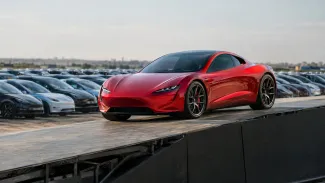
The demonstration in Texas
Tesla opened the evening with the Roadster driving upside down along a large ramp. Suction fans hold the car against the surface. Lars Moravy, Tesla's vice president of engineering, said on stage that the system can produce up to 2G of suction. The car then left the ramp, performed a barrel roll in the air using its cold gas thrusters and landed on its wheels. A second run had it hopping over a row of parked Teslas and rolling again in mid-air.
Elon Musk spoke to the crowd before the first attempt. Success was not guaranteed, he said, adding that it would probably work. The event was reported by InsideEVs, which is still updating the story.
The figures Tesla quoted
- Under one second from 0 to 60 mph, according to Musk.
- Up to 2G of cornering force.
- Up to 2G of suction from the fans, according to Moravy.
- Ten nozzles and 250 kg of compressed gas as propellant.
Musk said the thruster tanks refill themselves with compressed air, so the car carries its own supply. None of those numbers was measured anywhere outside Tesla's event. The runs happened on a ramp the company built for the occasion, and no independent test of the car on a track or a public road has been published.
Price and delivery date
Tesla gave no price for the car shown on Thursday. When the second-generation Roadster was first revealed in 2017, the company listed a base price of $200,000 and a Founders Series at $250,000 and said it would arrive as a 2020 model. That date passed six years ago. Tesla has not confirmed whether those figures still apply, and it said nothing about European pricing, homologation or the opening of an order book.
For buyers outside the United States, the central questions stay unanswered: whether the car will be sold in their market, and at what price.
Cars European families can actually order
The European market for large electric family cars keeps filling up while the Roadster stays out of reach. Xpeng's three-row G9L is on sale in eight European markets from €74,600. Chery opened a Frankfurt headquarters and is following its European hybrids with the Q, built around a 41-kWh battery. Both come with prices and delivery windows attached.
Charging matters more than a launch event for most households. Michelin's EV Charge platform now bundles 1.2 million European charge points with fleet cost data. Our own supercharger database tracks 483 locations, a separate list of the cheapest sites we monitor is updated alongside it, and the charging cost calculator turns a kWh price into what a specific trip costs.
Thrusters and suction fans
Neither system has a place in a family car today. The thrusters need 250 kg of compressed gas stored on board, and the suction fans only work against a flat surface built for them. Tesla has not described how either would behave on a public road, and it has not raised the question of European type approval for such systems.
What to check before ordering anything
If you are shopping in Europe this autumn, the numbers that decide the purchase are price, real-world range, charging speed in winter and boot volume with the seats up. Our EV catalog lets you compare those figures across models, and the range calculator gives an estimate for your own route rather than a WLTP number. Tesla has not said when European customers will be able to order the Roadster, or what it will cost.
Has Tesla delivered a second-generation Roadster to a customer?
No. The car was shown as a prototype in 2017 with a promised 2020 launch. The Texas event was a demonstration on Tesla's own ramp, and the company has not announced the start of production or a first customer delivery.
What is the difference between the suction fans and the thrusters?
The fans pull air from under the car to press it onto a surface, which is what allowed the upside-down run. The thrusters push the car through the air using cold gas from ten nozzles and 250 kg of propellant, which Tesla says the car refills itself from compressed air.
Source: https://insideevs.com/news/812151/2027-tesla-roadster-price-specs-release-date/