
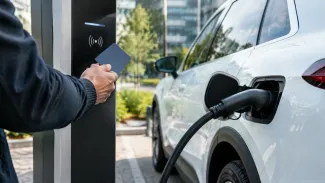
Michelin EV Charge is built with Dutch charging-platform provider Deftpower. It is aimed at company fleets, from sales cars and service vans to larger employee-car schemes, rather than private households buying their first electric car.
The offer sits inside Michelin’s MyConnectedFleet system. Drivers receive a charging card and app to locate stations, start sessions and plan journeys. Fleet managers see the charging sessions alongside vehicle location, energy use, battery status and trip information. Michelin says this can help companies spot expensive charging sessions and change charging habits.
One card, billing and vehicle data
The central promise is straightforward: fewer separate accounts and fewer invoices from individual charging operators. A driver might charge at a motorway hub in France one day and a workplace-adjacent public charger in Germany the next. Michelin EV Charge is designed to put both sessions on a central invoice and attach them to the right vehicle.
That matters for businesses trying to work out the real running cost of an electric fleet. The electricity price is only part of the picture. A company also needs to know whether a driver charged during an expensive peak period, used a high-priced rapid charger for a routine overnight stop, or could have charged at a depot instead.
Michelin says its platform offers transparent prices without additional network fees and may include negotiated tariffs in some cases. Fleet buyers should read that wording carefully. “No additional network fee” does not automatically mean that every charger will be cheap. Prices can still differ sharply between operators, locations and charging speeds.
For a quick comparison before a journey, drivers and small fleet operators can use our charging cost calculator. It helps turn a displayed price per kWh into a session cost before the vehicle is plugged in.
A large access figure needs context
The stated network of more than 1.2 million public charge points is a roaming-access figure across Europe, not 1.2 million chargers owned or operated by Michelin. It can include normal AC posts, destination chargers and rapid-charging locations from many different networks.
Scale is useful, but it does not tell a driver whether the next suitable charger is free, reliable or priced sensibly. For long motorway trips, charging speed, live availability and facilities for a break still matter more than the headline total.
Our own Supercharger database currently lists 483 locations. That is a much narrower network and a different type of charging offer, focused on Tesla sites rather than broad European roaming. A simple comparison shows Michelin’s claimed access total is roughly 2,485 times the number of locations in our database (1,200,000 divided by 483). It is not a like-for-like measure, since Michelin counts charge points and our database counts sites, but it shows why fleet managers need to look beyond one number.
For drivers who use Tesla’s network, our cheapest Superchargers list remains useful for checking where lower prices are available. A fleet card can simplify reimbursement, while route-level price checking can still save money.
Data can change charging habits
Deftpower provides the underlying MSP-2.0 platform. The company says its systems can use expected vehicle energy needs to move charging away from periods of higher demand or higher electricity prices where managed charging is possible. In 2025, Deftpower said that up to two-thirds of a charging session’s energy could potentially be shifted away from peak times.
That figure is a potential rather than a guaranteed saving. It depends on the car being parked for long enough, the charger supporting the function, and the business having flexibility over when vehicles leave. A delivery van required at 06:00 has less room to wait for cheaper electricity than an office car parked until morning.
Still, this is where integrated telematics can be useful. If a fleet manager can see that several cars regularly arrive home with enough battery for the next day, those cars may not need an expensive motorway rapid-charge session late in the afternoon. The platform can make that pattern visible.
Fleet electrification is expanding
Michelin is entering a market where corporate buyers are steadily adding electric vehicles but are still dealing with practical charging administration. The company’s announcement refers to the Arval Mobility Observatory Barometer 2026: in Germany, 57% of surveyed fleets already had electric vehicles and a further 19% planned to adopt them within three years.
Fleet demand also affects the vehicles available to families later. Company cars commonly enter the used market after leasing periods, so better charging and cost management can make an employer more willing to choose an EV in the first place. We recently reported on the Xpeng G9L’s launch in eight European markets from €74,600, an example of the larger electric cars that may appeal to executive and family fleets.
The charging infrastructure itself remains uneven. Tasmania’s support for 50 charging points at tourist accommodation is outside Europe, but it illustrates a familiar fleet problem: destination charging can reduce the need for costly public rapid charging if it is available where vehicles already stop.
What fleet managers should check
Before moving a fleet to Michelin EV Charge or another roaming service, managers should ask for the actual tariff list for the countries and routes their drivers use most. They should also check whether prices include VAT, how home charging reimbursement is handled, and whether drivers can see the final price before starting a session.
Data access deserves the same attention. Telematics can identify waste, but employers should set clear rules on who can view trip and charging information, particularly for vehicles used privately outside working hours.
Michelin EV Charge is now available through Michelin Connected Fleet in Europe. Michelin has not published a standard public price for the service; businesses will need to request commercial terms based on their fleet size and requirements.
Source: https://www.electrive.com/2026/10/14/michelin-launches-ev-charge-for-european-fleets/