
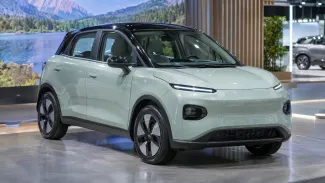
What Chery has confirmed
Chery's German operation will sit in Frankfurt am Main, with showrooms for the core Chery brand and for Omoda & Jaecoo. The group's European Operations Center opened in Barcelona in April 2026, which Chery describes as its first regional operations centre outside China.
Four models open the German launch, all from the Tiggo family and all hybrids: the Tiggo 4 as a full hybrid, the Tiggo 7 as full or plug-in hybrid, and the seven-seat Tiggo 8 and Tiggo 9 as plug-in hybrids. The Chery Q is the first all-electric model for EU markets and the first sold in Germany under the Chery name rather than a sub-brand.
The retail approach is conventional. Chery plans 30 partner dealers at launch and at least 100 sites across Germany by the end of 2027. Across Europe the company says it wants to be in 20 EU markets with 687 sales and service outlets in 2026, serving around 100,000 EU families, then 27 markets with 1,143 outlets in 2027. Chery has been China's largest passenger car exporter for 23 years and moved 275,000 cars in July 2026, of which 202,500 were exports and roughly half electrified.
Chery Q: the numbers
The Q measures 4.19 x 1.81 x 1.56 metres with a 2.70-metre wheelbase, 375 litres of boot space and another 70 litres under the front bonnet. The motor makes 89 kW. The battery holds 41 kWh.
Against the cars it will meet in German showrooms: the VW ID. Cross uses a 37 kWh entry battery and its entry motor produces less than 89 kW, while the 40 kWh Renault 5 E-Tech claims around 300 km of WLTP range. On published specifications the Chery Q carries the largest battery of the three.
Chery quotes 400 km of range on NEDC, a cycle that has not been used for European type approval for years. If the usual gap between the two cycles holds, WLTP would land somewhere between 320 and 340 km. Our own estimate, not a manufacturer figure: a small compact at 120 km/h draws roughly 20 kWh/100 km, which puts the Q near 200 km between motorway charges, and a Central European winter takes another 15 to 25 % off the WLTP number. Bjørn Nyland has not tested a Chery, so any real-world figure circulating today is unverified. Our real-world range calculator uses his measured data for the models where it exists.
Charging: 17 minutes from 30 to 80 %
Chery gives a window rather than a peak, but the arithmetic still helps. Half of 41 kWh is 20.5 kWh, and moving that in 17 minutes works out to roughly 72 kW average across the window. That is unremarkable for a small battery on a 400-volt system, and it is the figure that matters on a trip: about 100 km of motorway driving added per stop. V2L is confirmed.
Roaming and billing remain the weaker half of public charging in Europe. Michelin EV Charge now bundles 1.2 million European charge points with fleet cost data, which says as much about fragmented payments as about coverage.
Cost per 100 km
Assume 15 kWh/100 km in mixed driving. At a Czech household tariff of about €0.25/kWh (roughly 6 CZK) that is €3.75 per 100 km. On public DC charging at €0.55/kWh the same distance costs €8.25. A petrol compact at 6.0 l/100 km and €1.55/l costs €9.30. The saving sits at home, not on the motorway. Prices in our supercharger database (483 locations across Europe) vary enough between networks and countries that the per-100 km figure can nearly double depending on where you plug in. Run your own tariff through the charging cost calculator.
The German market it is entering
Chery's country director Patrick Reimers has called Germany challenging and German customers demanding, and said the timing was a matter of being neither early nor late. The core brand therefore arrives about three years after Germany ended its private BEV purchase bonus in December 2023. No state subsidy will soften the price. Company-car taxation still favours battery-electric cars at 0.25 % of list price per month.
In Austria, the full-hybrid Tiggo 4 starts well under €25,000, the only price anchor Chery's European range offers so far. To undercut the ID. Cross and the Renault 5, the Chery Q would need to land below €25,000. Competition inside the Chinese camp is already present: Leapmotor, Xpeng and Geely are all pushing into Germany. Not every Chinese model competes on price. The Xpeng G9L launched in eight European markets from €74,600. Chery says it aligns itself with Škoda and Hyundai instead. EU countervailing duties on Chinese-built BEVs, which run from about 7.8 % to 35.3 % depending on the exporter, apply to imports, one reason the company's European roadmap keeps mentioning localised research, development and production.
What a buyer should do
Wait for the WLTP figure and the price. The NEDC 400 km will not survive translation into European paperwork, and the German launch window is only described as later than the hybrids that arrive in the first half of 2027. Anyone shopping for a small electric car now should compare the 41 kWh Chery Q with the 37 kWh ID. Cross and the 40 kWh Renault 5 on WLTP range, DC time from 10 to 80 % and whether a heat pump is fitted. Chery has published none of those three things for the Q.