
What the study modelled
The paper is called "System-level assessment of dynamic reconfiguration for lifetime and cost outcomes in electric vehicle battery packs" and appears in Nature Communications. The authors are from Chalmers, with co-authors from PHINIA and Scania.
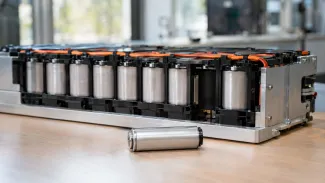
Cells inside a pack never age at the same rate. In a conventional architecture the weakest cell sets the ceiling for usable capacity, so one tired cell pulls down the whole string. Reconfigurable packs add switches and control electronics that change the wiring while the car is in use. A weak cell, or a group of cells, gets routed around and the rest keeps working.
The researchers illustrate the effect with an 80 kWh pack and 12,000 km a year. A conventional pack would be replaced after ten years in the model. The reconfigurable one reaches the same state of ageing only after around eleven years, about 14 months later.
The original report points out that the >20 per cent applies when every single cell can be controlled on its own. Group-level control is the realistic version, which puts the practical gain below that.
What the extra life is worth
Let us put a number on it. Assume an 80 kWh pack at €100 per kWh, so €8,000, roughly where global pack prices have been heading, though a retail replacement pack in Europe costs more than that.
Over 120,000 km the battery wear works out at €6.67 per 100 km. Stretch the same pack to 134,000 km, which is 14 months at the model's own mileage, and the wear drops to €5.97 per 100 km. The difference is about €0.70 per 100 km, or roughly €930 of deferred pack cost across the extra 14,000 km.
That is not a rounding error. At a Czech home tariff of €0.30 per kWh and 18 kWh per 100 km, electricity costs €5.40 per 100 km. On this model, battery depreciation is the larger line item. Move to public DC charging and the electricity side climbs past it; our cheapest supercharger list tracks what that looks like across 483 locations in Europe. You can run your own numbers in the charging cost calculator.
Most drivers never buy a replacement pack, so the benefit does not arrive as cash. It arrives as residual value, which is the second argument the study makes. The added electronics have to cost less than that gain for the maths to work.
Trucks and high-voltage cars gain most
The simulation expects the largest effect in electric trucks and long-range cars, because those are the packs with the most cells in series. One weak link hurts more when the string is longer. The models with the biggest packs in our EV catalog are also the ones carrying the most series cells.
The 14-month figure is a calendar number tied to 12,000 km a year. Express it in distance and it is about 14,000 km of extra service before the pack hits the same ageing state. A truck covering 100,000 km a year would burn through that margin quickly, which is why operators care about cost per kilometre rather than months. Charging sites for heavy vehicles are being built out in parallel, including the Vierzon hub in France designed for megawatt-class charging, and the pressure on pack lifetime in that segment is only going up.
Where Chinese suppliers fit
China produces most of the world's LFP cells, and cheap LFP packs have already spread well beyond the premium segment, including BYD's 26 kWh battery in the Suzuki e-Sky. A reconfigurable pack adds semiconductors and control electronics to every cell group. Whether it pays depends on the price of those parts against the value of the extra pack life, and that is a comparison Chinese pack makers have been winning for years.
There is a second effect on the production side. Cells must today be tested and matched so that each string is built from nearly identical units. A pack that can tolerate more spread between cells cuts that sorting work, which matters at the scale of a plant turning out millions of cells a month.
One thing is worth stating clearly. The industrial partners on the paper are Scania and PHINIA, not Chinese firms, and no large battery maker has announced a series-production reconfigurable pack.
What remains open
Chalmers published related work in May 2026 on an AI-based fast-charging strategy that claimed around 23 per cent longer life, also in simulation. The two approaches act in different places, one in the charging process and one inside the pack, and both land just above 20 per cent. Neither has been measured on a production battery.
The switches and control electronics also have to survive a vehicle's service life, including vibration, heat cycling and fault handling, and the system-level assessment in the paper does not demonstrate that. The study's own framing leaves the realistic gain under 20 per cent, because group-level control is what the authors expect to appear in hardware rather than a switch on every cell.
Source: https://www.electrive.com/2026/10/09/cell-bypass-aims-to-extend-the-usable-life-of-ev-batteries/