
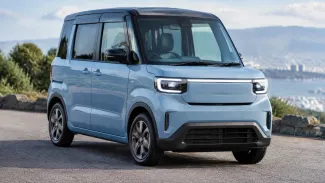
What Suzuki is selling
The e-Sky is 3,395 mm long, 1,475 mm wide and 1,625 mm tall, with a 2,460 mm wheelbase. That is the same footprint as the BYD Racco, which uses identical length and width figures but stands 1,800 mm tall. Kerb weight is 1,030 kg, the drive unit is Suzuki's own e-Axle, and the platform was developed for the car rather than adapted from a combustion model.
Three trims will be offered. The cheapest is built to order and aimed at corporate buyers, and it leaves out fast charging. Suzuki expects 1,000 sales a month across the whole range.
The list price starts at ¥2.12 million, about €11,600 at the conversion used in the source. With the Japanese government subsidy of ¥568,000, the effective consumer price can drop to ¥1.55 million, roughly €8,500. That is below the Nissan Sakura at ¥1.86 million after subsidies and the Racco at ¥1.99 million.
BYD supplies the battery
The cells come from BYD, and that is what makes the price possible. LFP chemistry costs less per kWh than nickel-based cells and holds up well over repeated cycles, but it stores less energy per kilogram and is more sensitive to cold. Suzuki chose to buy rather than build, unlike Japanese makers adding their own capacity elsewhere: Toyota recently opened a 2,800 m² battery centre in Michigan for hybrids, plug-in hybrids and EVs.
BYD continues to develop its own pack designs. We covered the company's patent for cells sitting in a dielectric fluid, which points at immersion cooling. Nothing in the e-Sky announcement says the car uses that approach.
Two different range tests
Suzuki quotes WLTP for the e-Sky. BYD quotes WLTC for the Racco. The cycles produce different numbers for the same car, so the headline ranges cannot be lined up directly. Consumption per kilometre is more useful, and the arithmetic reads like this: 26 kWh over 310 km is 83.9 Wh/km for the Suzuki. The Racco with a 22.4 kWh pack and 210 km works out at 106.7 Wh/km, and the 35.84 kWh version at 320 km at 112 Wh/km.
Weight explains part of the spread: 1,030 kg against 1,160 kg, and 1,220 or 1,230 kg for the bigger pack. The Racco is also 175 mm taller, which adds frontal area. A 130 kg difference does not account for a gap of more than 20% on its own, so the test cycle and body shape are doing some of the work.
The subsidy arithmetic does not add up
Two numbers in the announcement pull in different directions. Suzuki says the e-Sky undercuts the Racco by ¥20,000 before subsidies, which puts the BYD's list price at about ¥2.14 million. The same material gives the Racco's price after subsidies as ¥1.99 million. That implies a subsidy of roughly ¥150,000 for the BYD, against the ¥568,000 quoted for the Suzuki.
Japanese purchase subsidies vary by battery size, trim and buyer category, and the source does not explain the difference. Anyone comparing the two after-subsidy prices should check the exact version and who is buying it, because the gap depends on eligibility rather than on the sticker.
What 100 km costs
A 26 kWh pack in a 1,030 kg body is a good starting point for efficiency. Take the WLTP consumption of 83.9 Wh/km, add 30% as a rough allowance for mixed driving, and you land near 11 kWh/100 km. At €0.25/kWh that is about €2.75 per 100 km. A petrol kei car at 5.0 l/100 km and €1.50 per litre costs roughly €7.50 for the same distance. Change the tariff or the consumption figure and the gap moves, which is what our charging cost calculator is for.
The entry trim has no DC charging, so it is a home-charging car. On a 26 kWh pack the usable window is small anyway, and a charging stop adds range in short steps rather than hundreds of kilometres.
A small share of a big kei market
Suzuki sold 556,632 petrol kei cars in 2025. A target of 1,000 e-Sky units a month is 12,000 a year, around 2% of that volume. BYD has sold 1,800 Raccos since its July 2026 launch. For a European yardstick, EU electric car sales reached 1.64 million units, up 45%, with cheaper models carrying much of the growth, as we reported in our analysis of the EU sales figures.
Japan only, for now
Suzuki has not announced the e-Sky for Europe. There is no European price, no availability date and no indication that the model would pass EU type approval in this form. BYD is taking the Racco to Sri Lanka and Macao instead. The e-Sky is not in our EV catalog of 67 models because it is not sold here.
There is also no Bjørn Nyland measurement for the e-Sky, and none is likely while the car stays in Japan. For models he has tested, our real-world range calculator shows what a WLTP figure usually becomes in winter. For the e-Sky the only hard number is the 83.9 Wh/km derived from the WLTP claim, plus cold-weather LFP behaviour that Suzuki has not published data on.