
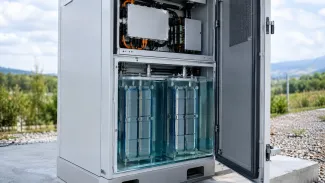
The two-chamber layout
Indirect liquid cooling is the standard today. Coolant runs through aluminium cold plates pressed against battery modules, and heat travels from the cell casing through several materials before it reaches that plate. Immersion cooling removes the plate. The modules sit in a non-conductive dielectric fluid, so heat leaves the wetted surfaces directly.
The trade-off is packaging. Fluid has to stay inside the enclosure, and every connector or electronic part not built for fluid exposure has to stay outside it. BYD's answer is a cabinet with an upper dry compartment holding the electrical equipment and a lower liquid compartment holding the submerged cell modules. The leads between them are routed through the upper part of the wet chamber rather than through its floor or side walls.
Hydrostatic pressure and seal height
The filing specifies dielectric fluid, including hydrocarbon- or ester-based formulations, rather than standard liquid coolant. A hydrocarbon fluid of that type sits around 800 kg/m³. Hydrostatic pressure is simple arithmetic: p = ρgh. At 0.5 m below the surface that works out at about 3.9 kPa, or 0.04 bar. At 0.2 m it falls to roughly 1.6 kPa. Moving a sealing interface 30 cm up the tank therefore cuts the pressure it sees by about 60%.
That is a small figure next to the couple of bar inside a cooling circuit, but a seal in a stationary cabinet has to hold for years, and lower pressure at the interface is easier to guarantee in production. It is the kind of detail that is trivial on a drawing and awkward on a line.
Cold plates versus immersion
Take a cylindrical 21700 cell with a 10.5 mm radius and 70 mm height. Its total surface is about 0.0053 m². In a 60 kWh pack built from roughly 4,600 such cells, that adds up to about 24 m² of cell surface. A flat cold plate reaches one end face per cell, about 0.00035 m², or roughly 1.6 m² across the same pack.
The comparison is rough. Production packs use prismatic or Blade cells with module frames, and heat still crosses the cell wall in either case. It does show where the attraction comes from, and where the cost sits. A vehicle has to carry the fluid, and a car pack is expected to work at -20 °C as well as at 40 °C. That is one reason immersion has stayed in stationary storage.
BYD's own storage systems, the MC Cube and MC Cube-T, use Blade cells with cell-to-system architecture and liquid cooling. CATL's EnerOne and EnerC put cooling plates outside the modules. CATL's Qilin takes another route for passenger cars, with a liquid cooling plate built into an interlayer between adjacent cells; CATL claims the 5C version lasts 1.8 million km even under ultra-fast charging. All of these keep the coolant in a defined path instead of around the modules.
What it means for buyers
Nothing changes in a showroom. A patent application is not a product, and BYD has not announced production plans for this cabinet. CN 122868832 A is still under substantive examination.
Thermal management is worth following anyway, because it decides how long an electric car holds peak charging power and how fast its pack degrades. Our real-world range calculator, built on Bjørn Nyland's measurements, shows how far tested figures sit from official ones; pack temperature is part of that gap. Our EV catalog lists pack size and DC charging data for 67 models if you want to compare.
Durability under heavy duty cycles is where the same question shows up on the commercial side. FedEx's $300 million electric truck order came with a claimed $800 million diesel saving that depends partly on how long those packs last. On the consumer side, EU electric car sales rose 45% to 1.64 million with cheaper models reaching showrooms, and those cars still cool their packs with plates.
For now, CN 122868832 A records an enclosure layout and one way of routing leads across a wet-dry boundary. Whether it reaches production is not stated in the document.
Source: https://carnewschina.com/2026/10/06/byd-puts-battery-cells-directly-in-cooling-liquid-in-new-patent/