
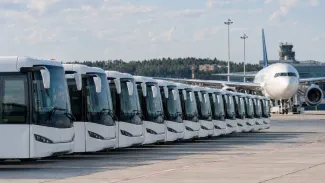
Twelve buses, three dual chargers
The vehicles carry up to 100 passengers each. Doors on both sides and a lowered entrance are meant to speed up boarding with luggage, prams or wheelchairs. Climate control is automatic, and the electric drivetrain removes the diesel rumble from the apron.
Three dual charging stations were installed. That gives six simultaneous connections for twelve buses, so half the fleet can charge at once. The electricity is contracted from renewable sources. Lithuanian Airports (LTOU) also took over passenger transport at the airport itself from 16 November, with a dedicated unit of 35 drivers.
The airport says the longer interval between charges makes vehicle rotations easier to plan during ongoing operations. For anyone sizing a depot, the ratio here is worth writing down: one dual charger per four buses, six plugs for twelve vehicles.
€600,000 per bus, service included
The €7.2 million is not a vehicle price. It bundles the twelve buses with a five-year contract under which Cobus handles maintenance, repairs, spare parts, remote condition monitoring and 24/7 technical support. Divide the total by twelve and you get €600,000 per bus, but the split between hardware and service is not published.
Airport apron buses are low-volume, custom-built machines, so this number should not be read across to city buses. In May the Vilnius municipal operator VVT ordered 112 MAN Lion's City E buses, 84 solo and 28 articulated, and did not disclose per-unit prices either. A €600,000 vehicle is a different category from anything in our EV catalog, which covers 67 passenger models with prices and specifications.
Bundling hardware with a long service contract is becoming common in fleet electrification. Meta signed a multi-year deal for 25 electric trucks on the same principle: the operator buys uptime, not just vehicles.
Three days per charge against twelve hours per tank
LTOU says the electric buses can operate up to three days on a single charge. The diesel buses it retired managed around twelve hours on a full tank. Six times the operating time, then.
That comparison measures time, not distance or energy. Airport transfer buses spend long stretches standing at the gate between short runs, so hours of operation can say little about kilometres driven. The company itself qualifies the figure with "depending on operating conditions". Battery capacity and charging power are not in the release.
Without those two numbers there is no honest way to compute cost per kilometre or cost per kWh for this fleet. Our charging cost calculator is built for cars with a known pack size. Here the pack size is unknown, which is why we are not publishing a €/100 km figure for Vilnius.
What 58 tonnes of CO₂ is worth
The airport puts the annual saving at about 58 tonnes of CO₂ against the diesel fleet. Per vehicle that is roughly 4.8 tonnes a year. A new petrol car emitting 120 g CO₂/km would need about 480,000 km to reach 58 tonnes.
Set against the emissions of the aircraft those buses serve, 58 tonnes is a small number. The local effect is the concrete one: no diesel particulates or nitrogen oxides where ground crew and passengers walk, and less noise at the gate. LTOU wants climate neutrality by 2030 and zero emissions from airport-controlled operations by 2040.
Lithuania's procurement rule
Since 2026, transport operators in Lithuania have been required to buy only buses with alternative drivetrains, and EU funds support fleet renewal. Twelve apron buses is a tiny volume next to the 112 city buses ordered in Vilnius this spring. It is also a complete replacement: the airport no longer runs a diesel bus for passenger transfers.
What is still missing
Battery capacity, charging power, energy consumption in service and fleet availability are all unpublished. So is the price of the electricity contract, which matters more than the sticker price in a fleet that charges on site overnight. Our supercharger database tracks 483 locations across Europe and their prices, but depot charging behind an airport fence follows different rules: schedules, dwell time and how many buses must be ready at five in the morning.
The twelve buses entered service on 16 November. The maintenance contract runs five years. After that LTOU will have its first real data on what these vehicles cost to keep running.