
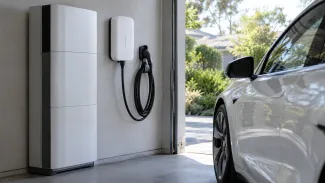
What Lunar presented
Lunar Energy, based in Mountain View, California, showed a home DC fast charger rated at 25 kW. The company says it adds roughly 100 miles of range in an hour, which is about 160 km. The unit feeds from the DC side of Lunar's home battery rather than from the house AC wiring, and Lunar says that arrangement avoids an electrical panel upgrade for the charger itself.
The connector options are CCS and NACS. Cars sold in Europe use CCS2, so the plug is not the obstacle here. The car's own hardware and software are.
The battery uses 5 kWh modules. A single tower holds 10 to 30 kWh. Towers installed side by side reach 300 kWh, and business configurations go up to 1 MWh. The inverter is rated at 13.4 kW. Lunar says assembly takes place in California, Georgia, Idaho and Washington.
On timing, the next-generation battery should reach customers in early 2027 and the charger in mid-2027.
25 kW next to an 11 kW wallbox
Most European family houses with three-phase power run an 11 kW wallbox. Take a car that uses 18 kWh per 100 km, a normal figure for a mid-size electric SUV: 11 kW puts back roughly 60 km of range every hour. At 25 kW the same car gains about 139 km an hour, a little under the 160 km Lunar quotes, because the company's figure comes from a more efficient vehicle.
Over a full pack the difference is clearer. A 77 kWh battery goes from empty to full in about seven hours at 11 kW, allowing for losses, and in roughly three hours at 25 kW. You can run your own numbers in our range calculator.
For a household that plugs in every evening, seven hours is plenty. The extra speed matters when someone arrives home late and leaves early, when two cars share one connection, or when the car has to be ready for a long drive on short notice.
What the electricity costs
Speed does not change the price per kilometre. Our charging cost calculator gives a simple comparison at 18 kWh/100 km. At a home rate of €0.25 per kWh, 100 km costs €4.50. On a public DC charger at €0.60 per kWh, the same distance costs €10.80. A driver covering 15,000 km a year pays about €945 less by charging at home.
A 25 kW home charger does not lower that figure. It moves the energy into a shorter window, which is where night tariffs and solar production come in. If your distributor offers a cheaper overnight rate, a faster charger lets you fit the whole session inside it.
The car as house backup
Vehicle-to-home is the part that changes how a family uses the car. A typical Czech household consumes somewhere between 8 and 10 kWh of electricity a day. A 77 kWh pack, kept at a 20% reserve, offers around 60 kWh. That is roughly six days of average consumption in theory, and two to three days in practice once you run a fridge, a boiler pump, lights and a laptop, and accept that heating is the first thing to go.
The limit is on the car side. Lunar lists CCS and NACS connectors but has not named which models support bidirectional charging. Charging an EV and taking power back out are separate capabilities, and plenty of cars on European roads today can only do the first.
What a European installation needs
A common Czech or German family house has a three-phase 400 V connection with a 3×25 A main breaker, which works out to about 17 kW. Pulling 25 kW would need roughly 36 A per phase, so either the service gets upgraded or a battery sits between the grid and the charger. Lunar chose the second route by connecting on the DC side. The battery still has to be filled from the grid, from solar panels, or both, and the 13.4 kW inverter sets how fast that happens.
Where home charging is not enough, route planning still decides the trip. Apps have improved on that front; we wrote about the PlugShare 8.0 update and its stop-distance feature, and Android users are still waiting for their version.
What is still missing
Two details decide whether this makes sense for a household: the price and the list of compatible cars. Lunar has published neither. The company also reports that its California customers using Lunar AI saved an extra $338 on average last year compared with a standard battery mode. That is a company figure and cannot be checked from outside.
Vehicle-to-grid payments depend on programmes being available where you live. Lunar's Gridshare platform manages more than 150,000 distributed devices and runs virtual power plants in California, Hawaii and Texas, with expansion in Utah, Nevada and New Jersey. The company also operates in Europe, the UK and Japan, but no European launch date or pricing for this charger has been announced.
Car-side support is moving. New models keep arriving with larger packs and, in some cases, bidirectional hardware, such as the Lucid Cosmos, targeted at around $50,000 with production from the second half of 2027. Whether any given model will talk to a Lunar charger is a question only the compatibility list can answer.
What to check before buying
Start with your main breaker and the age of your wiring. Ask the installer whether the connection can carry the charger's draw, and who pays if it cannot. Check the CCS2 socket on your car and, for backup power, ask the manufacturer in writing whether bidirectional charging is enabled or only planned. Ask what happens to the car's battery warranty if you use V2H regularly. And measure a normal week first: for most families an 11 kW wallbox plus a night tariff covers everything except the two or three long trips a year, which public chargers handle anyway.
Do I need a three-phase connection for a 25 kW home charger?
In practice, yes. At 400 V three-phase, 25 kW means about 36 A per phase, above the 25 A main breaker common in Czech and German family houses. Lunar avoids the problem by feeding the charger from the DC side of its battery, but the battery still has to be charged from the grid or from solar.
Does charging at 25 kW wear the battery faster?
There is no public long-term data on home charging at exactly this power. It sits well below the 150 to 250 kW that public fast chargers deliver, so the load on the cells and the heat generated are smaller. How much it matters depends on the car's cooling system and on how often you do it.
Source: https://electrek.co/2026/11/12/lunars-new-home-dc-fast-charger-puts-your-ev-battery-to-work/