
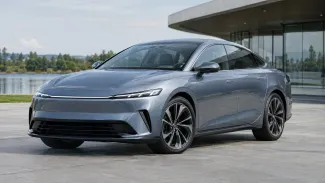
The announcement came from Volkswagen Group China as part of its programme for this year's China International Import Expo in Shanghai, which runs until 10 November. The car was designed jointly by Chinese and German teams and will be built by the FAW-VW joint venture.
The car itself
VW calls the ID. AURA L5 a pure electric family sedan. It is roughly the size of an Accord or a Camry, with a fastback roofline and a rear hatch instead of a separate boot lid. The production car is expected to use the 155 kW motor (about 208 hp) announced with the concept version. Battery capacity has not been published.
Two published figures matter more for daily use than the horsepower. The electric tailgate opens more than 70 degrees, and the opening is over 1,000 mm wide. Anyone who has tried to lift a folded pram or a child seat into a narrow saloon boot knows why that number is interesting. VW also quotes a "usable floor-area ratio" of 84.4%. That is the company's own measure, and it cannot be compared with a boot volume in litres.
Some versions of the AURA line will get lidar and a driver-assistance system VW calls Hyper Sense 8, described in the press release as an end-to-end large model. Frameless doors and semi-concealed handles are standard on the show car.
The software behind it
Cars sold in China under the VW badge increasingly run on CEA, the China Electronic Architecture. It is the software layer inside what the group calls VEGA, its locally developed technology matrix. VW Group China says CEA is already in five new models from three joint ventures, that software updates were completed this year, and that an internal AI toolchain called C-Brain is used in development, design and engineering checks.
Volkswagen has spent years trying to make its in-car software feel finished. The group is paying billions of dollars into a joint venture with Rivian for vehicle software rather than building everything alone. The Chinese architecture is a second route to the same goal, developed faster and closer to the market where software expectations are highest.
What Europe might borrow
Autocar's Greg Kable reported that, according to internal discussions confirmed by group board member and Volkswagen brand CEO Thomas Schäfer, up to 75% of the firm's core models in Europe could eventually use the China Electronic Architecture. Reuters reported on 26 October 2026 that Volkswagen is considering using Chinese software in Europe. Neither report says which models come first, and Volkswagen has not published a timeline.
The battery is the other half of the cost question. A Bruegel estimate we covered earlier put the effect of EU battery local-content rules at around €2,100 on a 60 kWh electric car. That figure applies to cars sold in Europe, not to the Chinese-built AURA, but it shows how much of a mainstream EV's price sits outside the software.
What a family would notice
We have not sat in this car, so treat the following as what the published numbers suggest rather than a test verdict. The hatch aperture is the practical highlight: wide openings help with child seats, prams, dog crates and the weekly shop in a way that a saloon boot never does. A 155 kW motor is in the same range as most mid-size electric family cars on European roads, enough for a loaded car on a motorway slip road.
Rear legroom, boot volume in litres, child-seat anchor access and the size of the screen are all unpublished. Those are the four things we measure first when a car arrives for family testing.
What is still missing
No battery capacity, no range figure, no charging curve, no price in yuan and no European launch plan. The car is being shown at a Chinese trade fair, in a market where several VW electric models are already sold at prices European buyers cannot get. Until those numbers exist, the ID. AURA L5 remains a Chinese-market product with a European software story attached.
What to do with this
If you are choosing a family EV in Europe this winter, the ID. AURA is not on your list. Use the announcement as a signal instead: software updates and hatch practicality are becoming selling points in the segment below €40,000, and the models that reach European showrooms in 2027 and 2028 will be judged on them. Our EV catalog lets you compare what is actually on sale, and the charging cost calculator shows what a family car costs per 100 km at home tariffs and on the road. For long trips, our Supercharger database currently tracks 483 locations across Europe.
VW Group China has published no battery capacity, no range figure and no price for the ID. AURA L5. The CIIE show in Shanghai closes on 10 November, and pre-orders open six days later.