
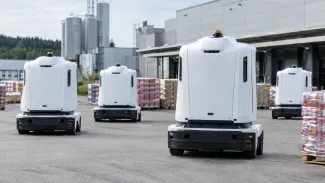
Four eBots and two backup trucks
Lorenz is headquartered in the Schwandorf district of Upper Palatinate and employs around 3,000 people. Its brands include Crunchips, Saltletts and NicNac's. The new fleet never leaves the fence: it shuttles finished goods, raw materials and empty pallets between production lines and the central warehouse.
The vehicles are Einride's cabless units, now branded eBot and shown earlier as the Gen 2 Rigid Large. No steering wheel, no accelerator pedal, 15 Euro pallets of load. Four of them run the internal traffic, with two ordinary electric trucks covering for any unit that is temporarily unavailable.
Throughput in numbers
Lorenz expects up to 1,200 pallets daily, with higher volumes at peak times. Divided by the 15-pallet capacity, that is 80 loads a day, or 20 per vehicle. At the stated 30 to 45 minutes per route, the midpoint gives roughly 12.5 hours of running time per vehicle per day. It fits a two-shift pattern, but without much slack. That is what the two backup trucks are for.
A rough energy estimate shows the scale. Assume an average 12 km/h inside the plant: 37 minutes is about 7.4 km, twenty of those is roughly 150 km per vehicle, around 600 km for the fleet. A loaded rigid electric truck of this size typically draws 0.9 to 1.2 kWh/km, so 540 to 720 kWh a day, or 0.45 to 0.6 kWh per pallet. At an assumed commercial rate of €0.20/kWh, that is €0.09 to €0.12 per pallet before the photovoltaic system is counted. Lorenz and Einride have not published consumption figures, route lengths or the price of the transport service, so treat these as our estimate, not theirs.
Charging from the factory roof
The eBots charge on site with electricity from the plant's own PV system. For a fleet, the number that matters is not the rooftop yield but the cost per kWh including grid demand charges, and PV output peaks at midday in summer while pallet flow may not. Our charging cost calculator works through that per-kWh picture, and the tariff calculator is the tool for commercial load profiles.
Einride keeps the keys
The commercial model is worth more attention than the hardware. Lorenz does not own the vehicles. The five-year project rests on a transport service agreement: the eBots remain Einride property, and Einride operates and manages them, with its Saga software handling planning and synchronisation. Remote and local operators monitor every run, and authorised staff can intervene from a distance.
“With this project, we're bringing a technology into industrial practice that is still widely discussed as a future scenario,” said Stefan Bender, Head of Logistics Germany at Lorenz. Henrik Green, Einride's CTO, pointed at German safety standards as the test case: “Deploying the technology successfully under these conditions is the strongest proof that it is ready to scale.” Lorenz received the German Logistics Prize 2026 in October for the underlying concept.
Private ground, public rules
All of this happens on company property, which is why German road-traffic approval for autonomous driving is not the deciding hurdle here. The constraints are internal safety rules, insurance and the interface with human forklift traffic. Einride's public-road work is a separate matter: since mid-September it has been testing an autonomous electric truck with Lidl in Hesse, capped at 25 km/h.
Where it sits next to other European fleets
Two models are emerging in European freight. Austrian logistics company Quehenberger is growing its electric truck fleet from 13 to 24 vehicles by the end of 2026: owned trucks, drivers in the cab, public roads, depot charging to organise. Lorenz bought none of that. It bought transport as a service on a closed site with no cab at all.
What a fleet manager can take from it
Three things transfer. First, the service contract shifts capital cost and technology risk to the operator, which matters when the vehicle category is still young. Second, redundancy is not optional: two conventional electric trucks for four autonomous ones is a 50% backup ratio. Third, measure kWh per pallet moved, not kWh per kilometre. That is the figure a plant logistics manager can compare against a diesel yard tractor.
What remains open is the data that would let another factory copy the setup. Einride and Lorenz have not disclosed the eBots' energy consumption, the length of a single route or the price per pallet in the service agreement.
Related reading and tools
For depot and public charging costs across Europe, our supercharger database covers 483 locations with prices, and the cheapest-charging list is updated from the same data. Fleet energy budgets are easier to sanity-check with the EV savings calculator.