
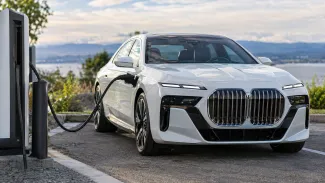
What the package contains
The offer covers cars bought or leased from the 2027 model year range. BMW's own ChargingNetwork is not a network in the physical sense. It is an access layer inside the My BMW app that reaches more than 180,000 public charge points in the US through partners including Shell Recharge, ChargePoint, EVgo and IONNA.
IONNA is the part with hardware behind it. It is a joint venture between BMW and seven other US automakers, with more than 200 locations and DC charging up to 400 kW. Members get 25 per cent off sessions there for twelve months.
Anyone who bought or leased an eligible 2027 car before the 5 November launch can still qualify. The catch is enrolment: owners have to set up the charging package in the app after purchase, and credits are then applied automatically to qualifying sessions. Once the balance is gone, the registered payment card gets charged.
How far $500 actually goes
Public charging is where the money disappears fastest. At an assumed $0.45/kWh, a common rate for US DC fast charging, $500 buys roughly 1,100 kWh. In a family SUV using about 19 kWh/100 km, that is some 5,800 km of driving.
The IONNA discount stretches things a little. If the $200 portion is spent inside the membership year, the 25 per cent reduction turns it into about $267 worth of charging, which pushes the total to roughly 1,260 kWh, or close to 6,600 km.
Put the same 1,100 kWh through a home wallbox at around $0.16/kWh and the bill is about $176. That gap is not a BMW problem. It is how public fast charging is priced almost everywhere. You can run your own figures in our charging cost calculator.
A credit, not a cheaper car
Set against the price of an i5, i7 or iX3, $500 is a small number. It reads better as a convenience: the first year of public charging is partly paid for, and the driver does not have to open four different apps to find a working stall.
The timing matters too. Federal purchase incentives that once reached $7,500 are no longer available for new electric cars bought after September 2025, so manufacturers are competing on the ownership experience instead of the sticker. Charging credits, free home wallboxes and network memberships are cheaper for a carmaker than a discount on the vehicle, and they keep the customer inside the brand's app.
Europe handles this differently
In the US, public charging build-out leans on automaker joint ventures and private money. In the EU it leans on law. The AFIR regulation sets minimum power and spacing for charging pools along the main TEN-T routes, and countries are measured against it.
Ireland is a useful example of how slowly that can go. Its strategy to 2028 targets a 280 MW network, and as we reported, that figure sits below the AFIR benchmark for the country. Demand is not the problem: Germany reached a 37 per cent BEV share in October, with petrol and diesel combined at 24.5 per cent.
So European buyers get a regulatory floor and a patchier map. US buyers get a commercial perk and one year to use it.
What to check before counting on it
First, where you charge. A household that plugs in at home almost every night will burn through $500 slowly, and the credit will expire before it is spent. A household that relies on public charging, or drives long intercity routes, will use it in a few months.
Second, whether IONNA sites sit on your usual routes. The 25 per cent discount only applies during the membership year and only at those locations, so it is worth checking the map before you treat the $200 as a guarantee.
Third, the expiry date. Credits and membership benefits run for up to one year from the retail sale date, not from the day you set up the app. A car bought in November 2026 and enrolled in January 2027 loses two months of value.
BMW has announced terms for the 2027 model year only and has not published figures for later cars. Enrolment is not automatic, and the credit clock starts at the sale, not at setup.