
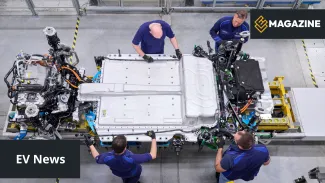
13 trucks become 24
By the end of this year Quehenberger plans to operate 24 of its own battery-electric trucks, up from 13. That is 11 additional vehicles, an increase of 85 %. The company has not named the customers the new trucks will serve, and it has not said which models it is ordering.
It has said where they will work: urban distribution, routes that can be planned in advance, and depots where charging can be built. The expansion includes new charging infrastructure, though Quehenberger gave no figures for installed power or the number of charge points.
Volvo, Mercedes and a MAN pilot from 2018
Quehenberger started early. In 2018 it was one of nine pilot customers for the MAN eTGM, a 26-tonne electric distribution truck that MAN later built in a small series. Its current fleet is known to include several Volvo FM Electric units, and the press photo issued with the announcement shows a Mercedes-Benz eActros 600.
The eActros 600 is the long-haul model: 621 kWh of installed LFP capacity and a manufacturer-claimed range of around 500 km in long-haul operation, with charging at up to 400 kW. That 500 km is not a WLTP type-approval figure, it is what the manufacturer claims for the duty cycle it was designed for. A 26-tonne distribution truck and a 40-tonne tractor unit have very different consumption, which matters once you start costing the electricity.
What 120 kWh per 100 km costs
Take the eActros 600 figures as a nameplate-derived estimate. The battery holds 621 kWh installed, of which roughly 600 kWh is usable. Dividing 600 kWh by the manufacturer-claimed range of around 500 km gives a round 120 kWh per 100 km. That is a first-principles number, not a measurement — real consumption will be higher with payload, winter temperatures and topography.
At an assumed €0.55 per kWh on a public DC charger — an average European commercial rate, VAT excluded — 120 kWh costs €66.00 per 100 km, or about €0.66 per kilometre. A diesel artic running 30 l/100 km at an assumed €1.50 per litre costs €45 per 100 km.
The picture flips at the depot. The same 120 kWh bought at an assumed €0.20 per kWh, a realistic commercial AC or low-power DC rate for a site with its own supply, comes to €24.00 per 100 km. That is roughly 47 % below the diesel figure. For a truck doing 60,000 km a year the difference between depot and public charging is around €25,000 annually, before any road-toll discounts for zero-emission vehicles. Both tariffs and the diesel price are assumptions, so substitute your own — the arithmetic holds, the inputs are yours.
Our list of the cheapest charging locations in our database of European charging sites shows how wide the price spread is across the continent, and the spread is exactly why hauliers try to keep as much energy as possible on their own site. You can model your own tariff with the charging cost calculator; the consumption figure is the only variable that changes the result by more than a few euro.
The dm contract and urban distribution
The customer base is already visible. Quehenberger delivered its first three electric trucks for the drugstore chain dm in 2024, and since spring 2026 it has served around 100 dm stores in Vienna with ten electric vehicles. Grocery and drugstore deliveries suit batteries well: short, repeatable routes, fixed depots, and a nightly window for recharging that no long-haul schedule offers.
Andreas Letsch, managing director at Quehenberger, said electric freight does not work on a "scattergun" approach and depends on analysing operational profiles and route planning. That is the same conclusion most fleet operators reach once they have run a handful of vehicles for a year.
60 % of the Austrian fleet
Quehenberger says the 24 trucks will represent 60 % of its Austrian fleet. Assuming the denominator is the same fleet, that implies around 40 vehicles in Austria (24 / 0.6 = 40). The 50 additional electric trucks planned within two years are more than twice the 24 electric vehicles the company will have at the end of 2026, and the resulting 74 electric trucks would far exceed the roughly 40 vehicles the 60 % figure implies for Austria. Either the total fleet grows substantially, or a large share of the new trucks sits outside Austria. Quehenberger has not explained the split.
The regulatory direction is set either way. EU regulation 2024/1610 requires new heavy trucks to cut CO2 by 45 % from 2030, 65 % from 2035 and 90 % from 2040, measured against 2019. The pressure shows in the car market first: Germany's BEV share hit a record 37 % in October, while the UK reached 32 %, just short of its 2026 mandate. Fleets buying trucks now are buying against a 2030 threshold, not a distant one.
What the numbers say
Eleven extra trucks is a small step by European fleet standards, and the business case rests on two things: a depot with cheap electricity and a duty cycle short enough to recharge overnight. Public charging at an assumed €0.55 per kWh makes a 40-tonne electric truck more expensive to run per kilometre than diesel. Quehenberger has not disclosed the models for the new vehicles, the customers they will serve, or the installed charging capacity behind them.
Source: https://www.electrive.com/2026/11/05/quehenberger-doubles-its-battery-electric-truck-fleet/