
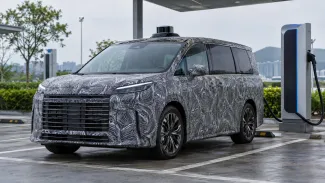
What the test car shows
The mule is still wrapped in camouflage, so the surface language is guesswork. What is visible is a boxy silhouette, a tall and wide front end with a large grille opening, and conventional pull-type door handles. The roof carries a LiDAR pod, the sensor layout BYD uses for the upper tiers of its God's Eye driver assistance system.
The gap between this and the Ocean-V concept shown at the Beijing auto show in April 2026 is wide. That concept had a sliding central screen and two named modes: Camping, where the seats fold flat or swivel to face each other, and Movie, where a screen flips out of the dashboard. Spy footage from ThinkerCar and photos via Autohome show none of that theatre, at least not on the outside. Whether the interior keeps any of it is the open question.
Size against the competition
On the reported dimensions the Ocean MPV sits just under the Denza D9 and slightly above the Kia EV9, which is the closest seven-seat electric rival sold in Europe.
| Model | Length | Width | Height | Wheelbase |
|---|---|---|---|---|
| BYD Ocean MPV (reported) | 5,145 mm | 1,970 mm | 1,805 mm | 3,045 mm |
| Denza D9 | 5,250 mm | 1,960 mm | 1,920 mm | 3,110 mm |
| Kia EV9 | 5,010 mm | 1,980 mm | 1,755 mm | 3,100 mm |
| VW ID. Buzz LWB | 4,962 mm | 1,985 mm | 1,927 mm | 3,239 mm |
Rival figures are manufacturer specifications.
All dimensions for the BYD come from Chinese local reports, not from BYD, and BYD has given no European launch timing or price for the Ocean MPV.
The 1,805 mm height matters more than the length for family use. It is low enough for most European underground garages, where the 1,927 mm ID. Buzz and the 1,920 mm Denza D9 start to run into height barriers. Our EV catalog has no BYD MPV listed yet, and this one would be the first candidate.
Plug-in hybrid looks more likely than BEV
BYD has confirmed no powertrain details. The grille is the tell: battery-electric MPVs in this class usually close the front off for aerodynamics, while a DM-i car needs airflow and a radiator. If it follows the pattern of BYD's other DM-i models, expect a Blade battery of roughly 15 to 20 kWh and an electric-only range quoted on the Chinese CLTC cycle, which flatters the number compared with WLTP. There is no European homologation figure, so no honest comparison is possible yet.
Pricing is the other gap it fills. Electrek quotes the Denza D9 at above 300,000 yuan ($45,000) and the Xia at 200,000 to 300,000 yuan ($30,000 to $45,000). The 200,000 to 250,000 yuan band — roughly €25,000 to €32,000 at about 7.7 CNY/EUR — is evmagazine.eu's own estimate, extrapolated from those two ranges; it is not a figure BYD or Electrek has reported. It also excludes VAT, transport and any European-market positioning, so treat it as a Chinese-market starting point rather than a showroom price.
What it would cost per 100 km
No consumption figure exists for this car, so everything below is a worked example, not a measurement. We start with a hypothetical battery-electric version of a 5.1 m seven-seater at 22 kWh/100 km, and then run the same 100 km for the DM-i case the grille points to.
Hypothetical battery-electric version, 22 kWh/100 km
- Home charging at €0.25/kWh: 22 × 0.25 = €5.50 per 100 km
- Public DC at €0.65/kWh: 22 × 0.65 = €14.30 per 100 km
- Petrol MPV for reference at 8.5 l/100 km and €1.55/l: €13.20 per 100 km
The expected DM-i case
A plug-in hybrid splits the same 100 km. Take a holiday run of 100 km: 60 km on the battery at roughly 20 kWh/100 km, which is 12 kWh, then 40 km with the battery depleted at 6.5 l/100 km, which is 2.6 l of petrol and €4.03 at €1.55/l.
- Battery filled at home at €0.25/kWh: 12 × 0.25 = €3.00, plus €4.03 of petrol = €7.03 per 100 km
- Battery topped up at public DC at €0.65/kWh: 12 × 0.65 = €7.80, plus €4.03 of petrol = €11.83 per 100 km
Use 7 l/100 km instead of 6.5 and the petrol share rises to €4.34, moving those two lines to €7.34 and €12.14. The order does not change.
Away from a home charger the picture collapses towards petrol. The hypothetical BEV on public DC lands at €14.30 per 100 km, slightly above the €13.20 petrol MPV, and the DM-i on a public top-up comes in at €11.83 — nearer the petrol line than the €7.03 you get from charging at home. That is the honest conclusion for a big seven-seat van: fast charging away from home costs about what petrol costs, and the plug-in hybrid only partly escapes it, because a 15 to 20 kWh pack covers the first part of a long day and then the engine takes over. Run your own numbers in our charging cost calculator, and check real DC prices on your route in the cheapest superchargers list built from our European charging price database.
The European angle: duties and where it is built
The EU's definitive countervailing duties, set in October 2024, apply to battery-electric cars imported from China. BYD's rate is 17.0% on top of the standard 10% import tariff, so 27% in total. Plug-in hybrids were not covered by those measures. A DM-i Ocean MPV would therefore arrive in Europe on a different cost base than a BYD BEV of the same size, which is a real commercial argument for the grille.
BYD already sells the Seal U DM-i plug-in hybrid in Europe, so the sales and service channel exists. The company also assembles cars in Szeged, Hungary, for the European market. Whether this MPV would come from there has not been said. Other Asian makers are expanding production outside China at the same time; Vingroup's €449 million plant in the Philippines is one example of the same logic.
What is still missing
No battery capacity, no electric motor output, no charging curve, no kerb weight and no European price. Chinese deliveries are targeted before the end of 2026, which leaves plenty of room for the production interior to differ from the concept. We will not publish a range estimate for this car until there is a WLTP figure or independent test data to work from; our real-world range tool exists precisely because the two rarely match.
Source: https://electrek.co/2026/10/29/byd-spotted-testing-new-minivan-video/