
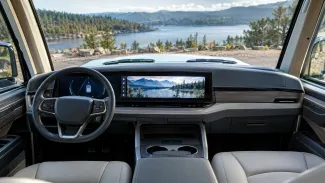
What the Embark is
The vehicle sits on a commercial chassis from Harbinger, a California startup that also builds electric trucks for FedEx. Entegra Coach, part of the Jayco group, adds the motorhome body. It has an 18,000 lb (8,164 kg) gross weight, is just under 30 feet long, has four berths, a 140 kWh pack, one 440 hp motor and a claimed 110 miles of electric range.
There are no slide-outs, the sections that power out from the sides of most large coaches. Jayco says the omission is deliberate: less weight, more range, better sealing and thermal behaviour. Photographs of the prototype show an interior closer to a rented apartment than to the usual motorhome fit-out.
79 kWh per 100 km
Convert the range claim and the vehicle becomes easier to place. 110 miles is 177 km, so 140 kWh over that distance works out at about 79 kWh per 100 km. A large electric SUV sits around 25 kWh per 100 km in mixed driving. The Embark is roughly three times thirstier, which is what 8.2 tonnes and a flat front will do to a consumption figure.
Total range with a full tank is quoted at nearly 450 miles, or 724 km. According to Harbinger, co-founder John Harris averaged 16 mpg on a cross-country trip, two to three times better than a typical V8 coach. In metric that is 14.7 l/100 km in US gallons.
Cost per 100 km
The electric mode is the cheap mode, as long as you can plug in. At €0.25/kWh the 79 kWh costs €19.80 per 100 km. At a public DC charger priced at €0.50/kWh, the same distance costs €39.50. Our charging cost calculator lets you drop in your own tariff and see the spread.
Running on the generator is not much worse. At 14.7 l/100 km and petrol at €1.60/l, the bill is about €23.50 per 100 km. A diesel Class A motorhome at 30 l/100 km and €1.55/l lands near €46.50. Those fuel prices are assumptions, not quotes, but the ratio holds across a wide range of them.
Using those assumptions, electric driving saves €26.70 per 100 km against the diesel coach (€46.50 − €19.80). That means a €40,000 fuel difference is reached after roughly 150,000 km. At roughly €345,000 the Embark costs more than many comparable diesel coaches of the same length. According to Harbinger, Harris argues the per-mile and maintenance savings close the purchase-price gap; that claim has not been independently tested.
Camping on 140 kWh
When parked, the traction battery becomes the house battery. That removes the separate genset most coaches carry, and it means air conditioning, cooking and electronics run from the same pack that drove you there. Jayco quotes a week or more of use without moving. If the pack runs low, the petrol engine starts in Camp Mode and charges it.
European campsite hookups are less helpful than they sound. A 10A supply at 230 V gives 2.3 kW, so filling 140 kWh from empty takes about 61 hours. A 6A hookup stretches that past 100 hours. Neither Jayco nor Harbinger has published a DC charging peak for this chassis, so there is no figure to compare with a car. For scale, our earlier look at the Denza N8's five-minute charging claim worked out to an average of 937 kW. Nothing in that league is claimed here.
Why it is unlikely to reach Europe soon
The weight is the first obstacle. With an 8,164 kg gross weight, the Embark sits above the 7,500 kg ceiling of the C1 licence category, so a European owner would need a full category C entitlement. That is a truck licence, with the medical and training costs that come with it. Most motorhome buyers in the EU never go near it.
The second is supply. There is no EU type approval, no European price and no distribution plan in anything Jayco has published. The rollout is American, deliberate and slow, which the company attributes to validation work on the dashboard interface and the charging experience.
A 140 kWh pack is also large by European standards, roughly double what a mid-size family EV carries. An ACEA-backed study we covered found Europe's planned cell capacity falling short of the EU's localisation targets, which makes niche, pack-heavy vehicles an awkward fit for this market.
What is still open
The tank size has not been published. If Harbinger's 16 mpg figure holds over the full 450 miles, the coach carries about 28 US gallons, or 106 litres, of petrol. Consumption with the air conditioning running in July, or in winter, has not been measured by anyone independent, and our range calculator cannot help without a certified figure to start from.
Jayco showed the vehicle in 2025, with series production planned for 2027. Two prototypes are with the rental company THL in Los Angeles, where customers can lease them short-term while Jayco collects telematics data on charging behaviour and battery depletion.
Source: https://insideevs.com/features/813127/entegra-coach-electric-rv-range-extender/