
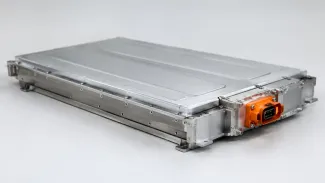
What Svolt announced
Chairman and CEO Yang Hongxin posted the roll-off on Weibo on Monday, together with a video in which he said the pack had secured nominations from several customers. The cells use separator transfer printing, which Svolt says improves intrinsic safety without compromising fast charging. Cooling plates sit above and below the cell stack. The underside has six layers of armour that Svolt claims delivers three times the impact resistance required by China's national standard.
Yang also said high-speed stacking pushes cycle life past 3,000 cycles, for a theoretical lifetime distance above 1 million km. All of these are company figures. None has been independently measured.
500 km in 12 minutes, converted to kilowatts
Twelve minutes for 500 km is 41.7 km per minute. Turn that into energy and the claim becomes easier to check. At 18 kWh/100 km, 500 km needs 90 kWh, which over 0.2 hours means an average of 450 kW. At 20 kWh/100 km it needs 100 kWh, and the average is 500 kW.
Svolt quotes 6C. On a 100-kWh pack, 6C is 600 kW. The claim therefore only holds if the pack averages roughly 75 to 83 percent of its peak across the whole 12 minutes, starting from an undisclosed state of charge, with the battery already at temperature. We ran the same arithmetic on Denza's five-minute charging claim, which implied an average of 937 kW, and the same caveat applied there: a peak figure and an average figure are two different numbers.
A 450 kW average on a 100-kWh pack is a sustained rate of about 4.5C. That produces heat, which is probably why Svolt cools both faces of the pack rather than one.
What the cycle life number implies
Divide the two lifetime figures. One million kilometres across 3,000 cycles is 333 km per cycle. For a 100-kWh pack that works out to consumption of roughly 30 kWh/100 km, well above what a car with this pack would use on a WLTP cycle. Either the lifetime distance assumes partial cycles, or it is calculated on a different basis than the range claim. Svolt has not said which. Our range calculator shows how much the consumption assumption alone moves a range estimate.
Semi-solid is not solid-state
Semi-solid cells, sometimes called solid-liquid hybrid, carry ions through a mix of solid and liquid electrolyte. All-solid-state cells use only solid electrolyte. Svolt argues the hybrid is not a stepping stone but a long-term product, particularly for cars using ternary chemistry. "It will become a mainstream technology over the long term," Yang said, adding that the company will push semi-solid first and all-solid-state afterwards.
Announced chemistry is not shipped chemistry. We covered a $108 million GM-led round for sodium-ion cells that are headed for grid storage rather than cars, which is a reminder that a chemistry headline and a production line are separate things. Svolt's line is at least real: packs have left Changzhou.
Where Svolt sits
SNE Research puts Svolt's global EV battery installations at 22.0 GWh in the first eight months of 2026, up 39.3 percent year on year, for ninth place and a 2.6 percent market share. In China it ranked tenth in September with 1.97 percent, according to CABIA, but fourth in the ternary segment with 6.31 percent. That ternary position is the part that matters here: the new pack is aimed at exactly that part of the market.
Cost and the charger outside the car
Svolt said in May that costs should land on par with conventional liquid-electrolyte lithium-ion cells. That matters more than the 12-minute figure. A pack that costs the same per kWh and charges faster is a straightforward gain; a fast pack with a price premium is a niche product.
The other limit sits outside the car. A 900 V, 6C pack needs a charger that can feed it, and most high-power stalls on European networks are rated at 350 to 400 kW, so a car with this pack would spend most of a European charging stop below its own ceiling. Our supercharger database covers 483 locations with their prices, and the charging cost calculator turns any price per kWh into EUR per 100 km so the comparison with diesel stays honest.
Europe's constraint is capacity as much as chemistry. An ACEA-backed study we reported on found the continent's planned cell output falling short of the EU's localisation targets, which is where a Chinese supplier with a working semi-solid line gains room.
What is still open
No European model has been confirmed with this pack, and Svolt has not said whether it will be offered to European OEMs at all. The first batch has left Changzhou. Its size, the vehicles that will use it, and the state of charge, temperature and charger behind the 12-minute number are all still unpublished.
Source: https://cnevpost.com/2026/10/26/svolt-begins-mass-production-100-kwh-semi-solid-packs/