
The deal
GM and Peak Energy announced their partnership on 10 June 2026. GM develops the sodium-ion cells, Peak integrates them into its storage platform and ramps up manufacturing in the United States. The October round is the money side of that arrangement: $108 million, with GM Ventures leading and LG Technology Ventures among the backers.
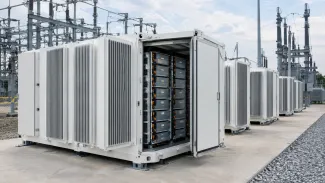
Peak says it will spend the money on three things. Expand US manufacturing. Fulfil more than $1 billion in existing customer orders. And take its passively cooled systems into the data centre market, where electricity demand from AI infrastructure is rising fast. The earlier GM–LG decision to shift a US plant from EV batteries to LFP energy storage points the same direction.
What Peak says the numbers are
Four claims stand out from the announcement. Storage cost down 20% against conventional systems. Uptime above 99%. No active cooling equipment, because the platform is passively cooled. And up to 2 TWh less annual battery-storage energy waste across the US if conventional lithium-iron-phosphate (LFP) systems were replaced by this design.
Sodium-ion is attractive here for a simple reason. Grid storage does not care much about weight or volume. It cares about cost per kWh, cycle life and safety. Sodium is abundant and the cells contain no lithium, so the material bill is lower and less exposed to lithium price swings.
What 20% means on a 100 MWh site
Peak does not publish a price per kWh, so here is our own arithmetic with an assumption stated openly: a turnkey LFP storage system at $150/kWh. That is our figure for the calculation, not the company's.
A 100 MWh site is 100,000 kWh. At $150/kWh the bill is $15 million. Twenty percent less gives $120/kWh and $12 million. The difference is $3 million on one project, before anyone touches the cooling equipment that Peak says it removes entirely.
The waste claim is worth the same treatment. 2 TWh is 2,000,000,000 kWh. Priced at $0.10/kWh, that is $200 million of electricity a year. Treat that as our conversion of Peak's estimate, not a company number. Real storage prices differ sharply between markets, and the $150 starting point moves with cell prices and installation costs.
Sodium-ion cells are heavier than LFP
This is why the cells are not going into a Chevrolet. Production sodium-ion cells typically sit around 100–160 Wh/kg. LFP cells are roughly 160–190 Wh/kg. To build a 60 kWh pack you would need somewhere near 500 kg of sodium-ion cells at 120 Wh/kg, against about 350 kg of LFP at 170 Wh/kg. Those are cell-level figures before pack structure, and the gap grows once you add the housing.
GM's vice president of battery and sustainability, Kurt Kelty, put it plainly: the application should determine the battery, and for grid-scale stationary storage sodium-ion is the right solution. He also confirmed the energy density is too low for EVs.
Grid connections and fast chargers
Charging power is climbing. Chery's 1.44 MW Volt-Dragon charger claims 10–97% in 6 minutes 50 seconds. A site like that needs a serious grid connection, and stationary storage is one way to buffer the peak instead of paying for a bigger connection. Our supercharger database of 483 European locations shows how much of that infrastructure is already priced and mapped; the cost per kWh a driver pays at the plug is calculated in our charging cost calculator.
For a driver, the metric is EUR per kWh at the charger. For a grid operator, it is dollars per kWh installed. Sodium-ion is being pitched at the second number only.
What the announcement does not say
There is no energy density figure for GM's next-generation cell, no price per kWh, no date for when the Michigan line starts producing and no word on European deployment. Sodium-ion still holds a small share of the global battery market, and most cell production sits in China, so a US-built sodium-ion supply chain would be a departure rather than the norm.
For scale, the $108 million round is modest next to the capital moving through the sector; Tesla's Q3 2026 capex plans alone run to $20 billion. Peak's own commitment is narrower: expand US manufacturing and work through more than $1 billion in existing customer orders.
Source: https://electrek.co/2026/10/23/gm-sodium-ion-battery-peak-energy/