
What the two sides agreed
According to Yinwang's statement, the deal covers both the swappable battery packs and the station network. CATL says the focus is on cars running Huawei's Qiankun smart driving system, which would be made compatible with Choco stations.
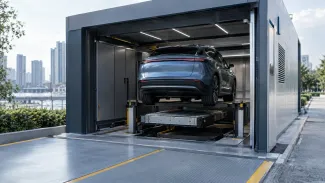
The automation is the part CATL is pushing. The car reads its own battery state and the driver's habits, picks a station, drives in on its own and lines up for the swap. CATL quotes 99 seconds for the swap itself. Chairman Robin Zeng and Jin Yuzhi, Huawei senior vice president and Yinwang CEO, signed the agreement.
What the announcement left out matters as much as what it contained. No models, no launch date, no service areas. A framework agreement is not a product.
Station count and growth rate
CATL entered swapping in 2022 with EVOGO and relaunched the effort as Choco-swap around standardised packs at the end of 2024. The network finished 2025 with 1,020 stations, passed 2,000 at the start of July and reached 2,520 on 29 September.
That is 520 stations in roughly 90 days, about 5.8 a day. The stated target is more than 3,000 by the end of the year, which means around 480 more in the remaining weeks of 2026, roughly 7.4 a day. The long-term figure CATL talks about is 30,000.
Split evenly, 2,520 stations across 200 cities is about 12.6 per city. They are not split evenly, and CATL has not published a regional breakdown.
2,520 stations against 483 in Europe
Our supercharger database tracks 483 locations across Europe, with the price per kWh at each one. Choco-swap alone is 5.2 times that count, in a single country. The comparison is not like for like: a swap bay serves one family of standardised packs, while a charging site serves any car with a plug. It still shows where the density sits.
On the money side, a swap is billed per kWh of energy in the pack plus the pack lease. For a European yardstick, our charging cost calculator puts 100 km at about €4.50 on Czech household electricity (€0.25/kWh, 18 kWh/100 km) and about €10.80 on a DC charger at €0.60/kWh. CATL has not published Choco-swap prices for the new partners, so there is nothing yet to set beside those two figures.
What 99 seconds means in kilowatts
If a swap hands over 50 kWh, those 99 seconds work out to an average of about 1.8 MW. No cable does that. The energy was pushed into the pack earlier, when demand on the local grid was lower, and the station carries the cost of the inventory sitting in its racks. Speed at the car, capital and grid planning at the station. That is the trade CATL is selling.
Swaps per station, from NIO's numbers
NIO built the first large network on its own and remains the only operator publishing volumes. It logged its 100 millionth swap in February and passed 110 million by June, with 3,790 stations. Ten million swaps in about four months is roughly 83,000 a day, or about 22 per station per day if spread evenly. CATL does not publish Choco-swap volumes, so there is no way to check its utilisation against that figure.
Who is behind Yinwang
Huawei holds 80%, with Seres and Changan's Avatr on 10% each. Seres builds AITO, the premium SUV brand that Huawei's software and retail network turned into a seller in China, and other automakers buy Qiankun systems too. GAC, BAIC and NIO are already Choco partners.
CATL supplies roughly 40% of the world's EV cells, which is the argument for standardised packs. Automakers dislike sharing the most expensive part of the car, and most of them are still developing their own chemistry and formats, as Li Auto showed with its own 5C pack at its October Power Day. A supplier with that market position is the one player an automaker cannot easily ignore.
The European footprint
Choco-swap has no announced passenger-car stations in Europe. The one European project CATL has confirmed is for trucks, a joint venture with Octopus Energy for the UK and Europe announced in June. On the charging side, Fastned reported Q3 charging revenue up 47% to €46.3 million with 65 stations under construction. Two different bets on the same problem, and only one of them is being built here.
The framework names no models and no dates. The next published milestone on CATL's side is the 3,000-station mark it wants by the end of December.
Source: https://electrek.co/2026/10/19/huawei-catl-battery-swap-choco-2520-stations/