
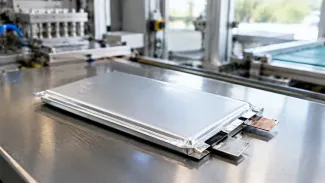
What Fraunhofer ISE tested
The cell is a 25 Ah pouch format, produced on an industry-scale pilot line rather than assembled by hand. Its anode is a silicon-carbon composite that accounts for 51 per cent of the active material, paired with a nickel-rich cathode. The work belongs to the StrOboBatt project at the institute in Freiburg.
After 1,000 full cycles the cell kept 83 per cent of its original capacity. Fraunhofer ISE notes that 1,000 cycles with at least 80 per cent retention is the usual threshold before a cell is considered commercially usable. Measured gravimetric energy density was 280 Wh/kg, against a projected 330 Wh/kg for optimised mass production.
Silicon's expansion problem
Graphite, the standard anode material, expands by about 10 to 12 per cent when it absorbs lithium. Silicon expands by up to 300 per cent, then shrinks back on discharge. That movement breaks electrical contact inside the electrode and speeds up electrolyte decomposition, so the cell loses capacity faster than a graphite cell would.
The composite approach limits the damage. It does not remove it.
Ten bar of pressure
The researchers ran the cells with 1,000 kPa of axial pressure, about 10 bar. At 300 kPa, roughly 3 bar, usable capacity fell noticeably faster. External mechanical pressure turned out to matter as much as the material recipe.
Ten bar sounds modest in force terms until you scale it. One thousand kilopascals is 1,000 kN per square metre, so every 100 cm² of electrode area carries about 10 kN, close to the weight of a tonne. A test rig can supply that. A vehicle pack has to supply it across the full cell area for a decade, through heat and cold, without adding a heavy compression frame.
Range at the same weight
At 330 Wh/kg, 100 kWh of cells would weigh about 303 kg. The same capacity at 280 Wh/kg weighs 357 kg. A pack adds modules, cooling plates and housing on top, so the vehicle-level gain is smaller than the cell-level one, but the direction is clear.
The practical version: a mid-size car that carries 75 kWh today could carry close to 100 kWh at the same battery weight. At 17 kWh/100 km, a consumption figure already above the WLTP rating of most mid-size EVs, 100 kWh gives roughly 590 km. Real-world range will be lower, especially in winter. You can check specific models with our EV range calculator, or compare official figures against Bjørn Nyland's measured real-world range.
Kilometres per thousand cycles
One full cycle of that 100 kWh pack covers about 590 km, so 1,000 cycles works out to roughly 590,000 km before the 83 per cent point. A typical battery warranty covers eight years or 160,000 km at 70 per cent retention.
A laboratory cycle count is not a warranty. Fraunhofer also tested under dynamic conditions and found capacity declining faster at high power than in gentle cycles. That is a note for the battery management system, which has to account for the effect, rather than something a driver would notice on a single trip. High-power charging is now ordinary equipment: Electrify America's 24-stall 350 kW hub near Orlando is one example of where cells like these would spend their life.
Cost per 100 km
None of this changes what a kilowatt-hour costs. At home, 17 kWh per 100 km at €0.25/kWh comes to €4.25. On a fast charger at €0.60/kWh the same distance costs €10.20, close to a petrol car at 6.5 l/100 km and €1.45/l, which is €9.43. Our database tracks 483 charging locations across Europe and lists the cheapest ones by price per kWh. For your own numbers, the charging cost calculator does the arithmetic.
Households without a driveway pay the fast-charger price more often. England changed its planning rules to allow cables across the pavement for exactly that reason, saving households up to £300.
The silicon cell makes a pack lighter or a car go further. It does not make electricity cheaper, and a buyer choosing between a 75 kWh and a 100 kWh version still pays for the extra cells.
Raw material
Graphite is mostly imported from outside Europe. Silicon can be produced synthetically in Europe, according to Fraunhofer ISE, so a larger silicon share moves part of the value chain closer to the cell factory. That is an industrial argument, not a driving one.
What the test leaves open
The results cover cycle life at one pressure level and one cell format. The institute's announcement gives no calendar ageing data, no cost per kWh, no pack-level demonstration and no description of how 10 bar would be maintained inside a vehicle pack over its service life. Those are the figures to watch before a silicon-rich anode reaches a showroom.