
Q3 in numbers
Gross profit rose 44 per cent year on year to €37 million, and the e-credit timing had no effect on that line. Charging volume on existing stations grew 27 per cent, against 29 per cent growth of the BEV fleet in Fastned's markets, so the network broadly kept pace with the cars rather than gaining share. Annualised energy throughput per station was 596 MWh.
Spread across 8,760 hours, 596 MWh comes to roughly 68 kW delivered continuously from an average location. Fastned builds sites with several charging points, some rated at up to 400 kW, so the 68 kW is an average load, not a peak.
About €0.66 per kWh
Two disclosed figures combine into one that Fastned does not publish directly. Annualised revenue per station of €395,000 divided by 596 MWh of annualised energy gives roughly €0.66 per kWh. It is an average across the Netherlands, Germany, Belgium, France, Switzerland and the UK, and it includes whatever the new kiosk format sells alongside electricity, so treat it as an order of magnitude rather than a price list.
Put that into a car. At 20 kWh/100 km, €0.66 per kWh works out to €13.26 per 100 km. Home charging at an assumed €0.25/kWh gives €5.00. A petrol car at 6.5 l/100 km and €1.65/l sits at about €10.73. Highway fast charging is priced as a convenience product, and on this arithmetic it can cost more per kilometre than fuel. Our charging cost calculator lets you plug in your own consumption and tariff instead of my assumptions.
What a station earns and what it costs
Fastned's earlier disclosure put average investment per location at around €892,000, covering charging hardware, grid connection, transformer technology and the solar canopy. At the confirmed target EBITDA margin of roughly 45 per cent, an average station turning over €395,000 a year would generate about €178,000 of EBITDA. Against €892,000 of capex, that is around five years before interest, tax and depreciation.
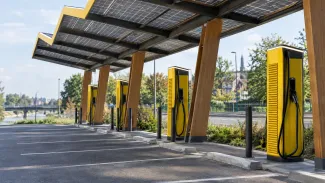
The build-out is speeding up. The 65 stations under construction are almost double the number a year ago. Guidance for the full year is unchanged at 70 to 100 new stations, which would take the network to 476 to 506 locations by the end of 2026. Year-to-date annualised revenue per station sits near the top of the €350,000 to €400,000 forecast range, helped by holiday traffic.
Germany, Belgium, France
Germany is approaching 70 locations, 17 of them built under the Deutschlandnetz tender. Fastned frames those tenders less as a subsidy and more as access to busy corridors and dense regions. Belgium now has 60 stations, including Libin Galaxia in Wallonia with twelve charging points at up to 400 kW. In France the company opened its first own kiosk, at Thionville-Yutz, to test retail at sites with little around them.
On the demand side, a September partnership with the Dutch mobility association ANWB puts Fastned in front of more than 600,000 charge-card users, with a 10 per cent discount at Fastned stations across Europe. Building AC charging at destinations is a different business with different economics, as our report on 120 Wallbox AC chargers at Montréal airport shows.
Financed with bonds
Growth is still paid for largely with borrowed money. Total liabilities stood at €514.6 million at the end of the first half, up from €409.8 million at the end of 2025. Capital expenditure on the network was €44.7 million in H1 and the company posted a loss of €13 million over the same period. A second bond issue in 2026 raised €36.5 million, and around €337 million of retail bonds had been collected by the end of June, carrying 6 per cent interest and a five-year term. The third retail bond of 2026 is open until 30 October. Our piece on the Fraunhofer study on shared truck charging covers a different route to spreading infrastructure cost.
What drivers can take from it
The practical reading for a European EV owner: the network is filling in along motorways in Germany, Belgium and France, which shortens gaps on long routes, while the per-kWh price at an average Fastned site stays well above home charging. If your route allows an AC top-up at the destination, take it and use DC on the move. Our supercharger database currently lists 483 locations with prices, and the cheapest chargers page sorts them by cost per kWh, which is the number that matters when you are comparing a 400 kW site with a 50 kW one.
Fastned's own guidance remains 70 to 100 new stations for 2026 and a network of 476 to 506 locations by the end of December. The third retail bond issue closes on 30 October.