
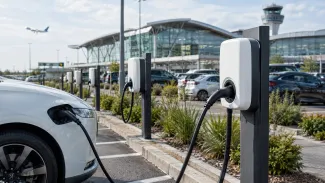
What was installed in Montréal
The hardware is Wallbox's Pulsar Pro, an AC charger for long parking stays rather than quick motorway top-ups. The 120 points are meant for airport employees, operations staff and visitors. EDP électrique coordinated the project, with Foresta providing the management platform that handles payments and central control, plus electrical contractor EG Électrique and distributor Westburne.
The site uses Wallbox's Power Sharing, which splits the available electrical capacity across groups of chargers. In plain terms: the airport did not have to buy a grid connection big enough for every charger running at full power at the same time. Electrive reported the story on 17 October.
Why shared power changes what you get
Power sharing is a sensible answer to a real constraint. Most sites have a connection limit, and a car park full of chargers idling at maximum draw is expensive capacity that sits unused most of the day.
The trade-off lands on the driver. If you arrive when half the bays are empty, your car may take the full rated power. Arrive on a busy Monday morning and the chargers in your group divide the same capacity between more cars, so each one charges slower. For a car parked for eight hours that rarely matters. For a two-hour stop before a flight it can. A Fraunhofer study on shared depot charging for trucks put the saving at €16,000 over five years per fleet, which is why operators keep choosing this design.
Who actually benefits
Employees first. Someone on a shift pattern who lives in an apartment without a private parking space can leave the car plugged in for a whole working day and drive home on cheap electricity. That group is the quiet majority of charging demand at workplaces and transport hubs.
Travellers come second, and the benefit is narrower. A week in a car park with an AC point means you return to a full battery and skip the search for a charger on the way home. Without a charging bay, a week of standby drain costs a few percent of range, not a flat battery.
Parking fees usually dwarf the electricity. That is the honest comparison, and it is the same in Prague, Vienna or Manchester as in Montréal.
What a charge at the airport costs
Take a family car that needs 40 kWh to get back to full. At a household tariff of around €0.25/kWh, that is about €10 at home. Public AC charging in Europe often runs €0.40 to €0.60 per kWh, so the same 40 kWh costs roughly €16 to €24. Put your own tariff and the operator's price into our charging cost calculator before you decide it is worth the detour.
A difference of €10 or so disappears next to a week of airport parking. Charge at the airport for convenience, not for savings. Our EV tariff calculator shows what a dedicated overnight tariff does to the home side of that sum.
The European comparison: Munich
Wallbox supplied 275 charging points to a car park at Munich Airport in 2025, using eM4 AC chargers with outputs of up to 22 kW and supported by 3 MW of rooftop solar. That sits inside the airport's NetZero 2035 strategy. It is a bigger installation than Montréal's eventual 168, and the published power rating is one detail Montréal's project does not yet have: the partners have not disclosed the individual power ratings of the Pulsar Pro units there.
What to check before you rely on airport charging
Four things decide whether an airport bay is useful or just a nice photo.
Power rating. An 11 kW AC point refills most family cars overnight. A 3.7 kW point needs a very long stay to matter. Ask, or check the operator's app before you park.
Pricing model. Some operators bill per kWh, some per minute, some add an idle fee once charging finishes. A per-minute tariff turns a slow shared-power session into an expensive one.
Cable. Most public AC points in Europe are untethered Type 2 sockets, so the cable lives in your boot. Check the connector type on the listing.
Access. At YHU the points serve employees, operations staff and visitors, which suggests different areas may have different rules. The same applies at European hubs: staff charging in a restricted zone is no help to a traveller.
For route planning we keep a charging station map and a database of 483 fast-charging locations in Europe, with the cheapest sites listed separately. If you are comparing the whole cost of the trip rather than one charging stop, the EV savings calculator puts home charging, public charging and fuel side by side.
The YHU build is designed to grow: 48 more points will follow the new building. No completion date has been given, and no price for drivers using the 120 existing points has been published.
Source: https://www.electrive.com/2026/10/17/wallbox-installs-120-ev-chargers-at-montreal-airport/