
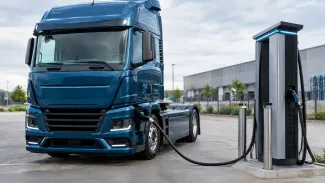
What the project examined
Transportation in Charge (TiC) launched in April 2023, funded by Germany's Federal Ministry for Economic Affairs and Climate Action and led by the Fraunhofer Institute for Manufacturing Technology and Advanced Materials (IFAM). At the time, neither the Mercedes-Benz eActros 600 nor the MAN eTGX was in series production, and batteries of around 600 kWh had no matching charging infrastructure on the market. The project accompanied the ramp-up with two practical partners, Behrens Group and Rhenus Home Delivery, and has now published its action recommendations, a guide and a legal opinion on shared charging.
Grid connection, not the truck
Industrial estates host logistics depots, distribution centres and production sites, so they concentrate both vehicles and electrical load. That is the argument for charging there rather than at public stations. The catch is capacity. Without a medium-voltage connection, ultra-fast charging only works with on-site PV and battery storage. The project's recommendations put responsibility on grid operators, because fleet electrification only scales if commercial and logistics areas get enough connection capacity. "The electrification of large truck fleets only succeeds if we view industrial estates as a holistic system," said project leader Sönke Stührmann, who lists early coordination between companies, grid operators and municipalities as a precondition. Technical solutions alone, he says, are not enough.
How much power a depot needs
There is no single answer. In the practical cases examined, overnight depot charging for a long-haul fleet needed 50 to 100 kW per vehicle. Tightly scheduled shuttle operations, where trucks are in and out during a shift, needed 200 to 350 kW. Both figures shape the grid connection, transformer and site layout, which is why the project recommends settling them before ordering trucks.
The five-year cost comparison
The case study covers ten electric trucks held for five years, each covering 60,000 km a year. Fraunhofer IFAM puts the electric fleet at around €352,859 and the diesel equivalent at €367,974. When third parties buy electricity from the same pool, the electric figure drops to €336,903. That is €15,956 less than the base case and an earlier break-even. The project also assumes a charging price of roughly 30 cents/kWh is enough to match diesel even without sharing. The published totals are not broken down per vehicle, so they cannot be read as a per-truck cost.
What 30 cents per kWh means on the road
Our own arithmetic, using a long-haul truck at 1.2 kWh/km: 100 km takes around 120 kWh, which at 30 cents/kWh costs €36. A diesel artic at 30 l/100 km and a bulk price of €1.70/l costs about €51 per 100 km. The gap is €15 per 100 km, roughly €9,000 a year per truck at 60,000 km. That is energy only. Fraunhofer's totals also include the vehicle, maintenance and charging hardware, so the two sets of numbers are not directly comparable. Our charging cost calculator runs the same arithmetic for passenger cars, which use roughly a quarter of that energy per kilometre.
Shared charging needs contracts
Joint use raises questions hardware cannot answer: who owns the charger, who has priority when two fleets need it at once, how the electricity is metered and billed, and what happens when one company leaves the site. That is why the project produced a separate guide and a legal opinion rather than a technical datasheet. Stührmann names transparent roles and trust between the parties as preconditions, alongside a clear legal framework.
Depot prices are not public prices
The 30 cents/kWh in the case study is a depot figure, with no retail margin, no roaming fee and usually a cheaper grid tariff. Public high-power charging is a different market, and prices vary widely across Europe. Our supercharger database tracks 483 locations, and the spread between the cheapest and most expensive sites is one reason fleets plan depot charging first. Public charging matters for routes that cannot start and end at the same depot, and that segment is being built out: Milence, the Daimler Truck, Traton and Volvo joint venture, runs truck-specific hubs, and the EU's AFIR regulation obliges member states to provide charging pools along the TEN-T network. Fleet cost data and charging networks are also being bundled commercially, as we reported when Michelin EV Charge linked 1.2 million European charge points with fleet cost data.
What the buyer takes from it
The order of operations matters more than the truck model. Check the site's connection capacity first, size the charging power from the duty cycle, then decide whether a neighbouring company can share the pool. The TiC action recommendations, the shared-charging guide and the legal opinion are available for download from the Fraunhofer IFAM website. The case study assumes a five-year holding period and 60,000 km per vehicle per year; other duty cycles are not covered.