
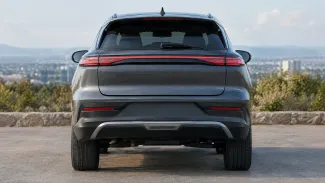
What the filing lists
The AWD Tang measures 5,045 mm long, 1,980 mm wide and 1,740 mm tall on a 2,950 mm wheelbase. Track width is 1,700 mm front and rear. Against the second-generation car it is 145 mm longer, and the wheelbase grows by 130 mm. Top speed rises by 70 km/h. Seating drops to five, where the old car offered six and seven seats.
The front axle uses an asynchronous motor with 215 kW peak and 75 kW rated output, model YS230XYF from Dongguan FinDreams Powertrain. The rear axle gets a permanent-magnet synchronous unit rated at 300 kW peak and 150 kW rated, model TZ205QYD from Xi'an BYD Automotive Components. Combined peak output is 515 kW. The battery is lithium iron phosphate, cells from Wuwei FinDreams, pack assembled by Zhengzhou FinDreams.
Tyres are 245/45 R21, with an optional 265/45 R21 rear fitment at load index 112, which equals 1,120 kg per tyre. Bosch supplies the BWA/ESP system. Listed options are exterior trim, wheel designs, roof racks and side steps, either electric or fixed. This is a proposed listing, not final production approval, so the numbers can still move.
Payload of 455 kg
Gross vehicle weight minus curb weight gives 455 kg. Spread over five seats that is 91 kg per seat before anyone loads a bag. Five adults at 80 kg use 400 kg of it, which leaves 55 kg for luggage.
For a 5.05 m family SUV with 691 hp, this is the least glamorous figure in the document and probably the one that decides whether a summer holiday works. Chinese and EU homologation do not define payload identically, so read 455 kg as an indicator, not a final European number.
Battery, range and the CLTC gap
The filing does not state battery capacity, range or charging power for the 515 kW version. The wider third-generation Tang EV line is listed with 88.682 kWh and 105.792 kWh packs and CLTC ranges of 730, 830 and 850 km, and the source report does not match capacities to the AWD variant.
CLTC is generous. A rough conversion puts WLTP 15 to 20 percent below the Chinese figure, so 850 km CLTC would land near 680 to 720 km WLTP. Motorway running at 120 km/h takes another 20 to 25 percent off, which puts the big-pack car somewhere around 500 to 550 km between stops. With roughly 102 kWh usable, that is about 19 to 20 kWh/100 km. Other assumptions can be run through our EV range calculator.
Charging data is missing entirely. Peak kW on a spec sheet is easy to print. The time from 10 to 80 percent is what decides whether a long trip works.
Size against the Da Tang and the Kia EV9
BYD launched the larger Da Tang EV in China on 17 June 2026: 5,263 mm long, 3,130 mm wheelbase, seven seats, from 239,900 yuan (about $35,500). The new Tang is 218 mm shorter with a 180 mm shorter wheelbase and two fewer seats. BYD has not explained how the two models divide the market.
A European reference helps. The Kia EV9 is 5,010 mm long on a 3,100 mm wheelbase with seven seats, and specifications for it and other European models sit in our EV catalog. The Tang is 35 mm longer than the EV9 while its wheelbase is 150 mm shorter, and it seats five. The EV9's dual-motor version makes 283 kW at about 2.6 tonnes. The Tang's 515 kW over 2,520 kg works out at roughly 204 kW per tonne, against about 110 kW per tonne for the Kia.
Running costs in euros
Assume 20 kWh/100 km on the motorway and 17 kWh/100 km mixed. Home charging at €0.25/kWh gives €4.25 to €5.00 per 100 km. Public DC at €0.65/kWh gives €11 to €13. A petrol SUV at 8 l/100 km and €1.45/l costs €11.60. Charged only on motorway rapids, the electric Tang lands close to the petrol car.
Those tariffs move. Fastned reported Q3 charging revenue of €46.3 million, up 47 percent year on year, with 65 stations under construction. Our cheapest-superchargers list and the charging cost calculator work from the prices stored for the 483 locations in our database.
What the document does not say
Capacity for the 515 kW version, charging power, WLTP range, price and European availability are all absent. DiSus-A air suspension and the DiPilot 300 driver-assistance package are reported by Chinese media, but the filing confirms neither, and whether they are standard or optional on this version is unsettled.
The Tang name has been sold in Europe before, so a European launch is plausible. Any such plan would also run into the EU's proposed 2027 cap on Chinese-built EVs, which we covered in our September European sales round-up. Nothing in the filing confirms timing or volume.
Launch in China is expected in the fourth quarter of 2026. The document that answers the remaining questions is the final approval, not this proposed listing.