
The filing
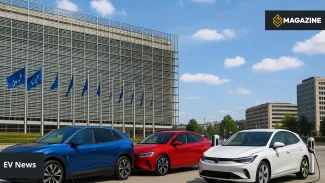
Two registers were hit on the same day, EUIPO in Alicante and the DPMA in Munich. That combination points at a car built for European sale, not a one-off concept badge. The entry-level model is not expected to reach the United States.
A trademark application proves intent and nothing else. Carmakers register names in batches and let most of them lapse without a press release. Treat ID. UP as the probable name, not the confirmed one. It does fit the direction Volkswagen has taken with the ID. Polo, the ID. Cross and the planned ID. Tiguan, where numbers give way to nameplates buyers already know. The original Up! measured 3,600 mm and left showrooms in 2023.
The car underneath
Volkswagen showed the shape as the ID. EVERY1 concept in March 2025. The production car is quoted at 3,880 mm long, 280 mm more than the old Up! and 173 mm less than the ID. Polo. Four seats, a 305-litre boot. The promised minimum range is 250 km, the motor is rated at 70 kW (94 hp), top speed 130 km/h.
The pack is expected to be the same 37 kWh LFP unit used in the ID. Polo, which quotes up to 334 km WLTP. Volkswagen has not published usable capacity, DC peak power or a charging curve. Those three numbers will decide how the car behaves on anything longer than a commute.
Price per kWh of battery
Divide the announced price by the expected pack size and a comparison falls out:
| Model | Price | Pack | € per kWh |
|---|---|---|---|
| ID. UP (target price, expected pack) | €20,000 | 37 kWh | €541 |
| ID. Polo standard version | €24,995 | 37 kWh | €676 |
Note: the 37 kWh pack is the entry battery quoted by Volkswagen for the ID. Polo; the pack size of the €24,995 version is not separately confirmed, so the €676 figure rests on that assumption.
Volkswagen's €20,000 is a target, not a configurator entry, while the ID. Polo figure is a real list price. Even so, the gap is €4,995 for the same 37 kWh of cells. Some of that is margin, some is equipment, some is simply the cost of building a smaller body. The cheapest way to read it: this is what moving one size down does to the sticker.
Charging cost per 100 km
Consumption is the soft spot in every estimate here, because nobody outside Volkswagen has driven the production car. Take 15 kWh/100 km as a working figure for a small EV outside the WLTP cycle. Run it through our charging cost calculator at three price levels, with the usual caveat that these are illustrative EU averages, not quotes:
| Energy source | Price | Cost per 100 km |
|---|---|---|
| Home AC | €0.25/kWh | €3.75 |
| Public AC | €0.45/kWh | €6.75 |
| Public DC | €0.69/kWh | €10.35 |
| Petrol hatchback, 5.5 l/100 km | €1.50/litre | €8.25 |
Home charging undercuts the petrol car by more than half. Public DC costs more than petrol. That split is not new, but it bites harder on a 37 kWh pack: the smaller the battery, the bigger the share of charging that happens away from home, especially for a driver without a garage. The hardware side is moving as well, as our piece on Lunar's 25 kW DC home charger shows.
For route planning, our supercharger database tracks 483 locations across Europe and the cheapest locations page sorts them by price per kWh. A car with this pack size will stop more often, so the price at each stop matters more than on a 77 kWh long-range model.
Rivals in the same band
Renault has put the Twingo E-Tech below the €20,000 mark, Citroën sells the ë-C3 above it, and the group's own Škoda Epiq and Cupra Raval share more than 80% of their components with the Volkswagen. Volkswagen says the Electric Urban Car Family has taken nearly 150,000 orders since series production began in June. The price band, at least, is not the obstacle.
What the family does not solve is charging outside cities. The TML report for ACEA found the build-out running at very different speeds between member states, which matters for a car bought partly because it is cheap to run.
What the winter test will show
334 km WLTP on the ID. Polo is a lab number taken at moderate temperatures with no heating load. Bjørn Nyland's real-world tests on small EVs regularly land well below the official figure once the heater is on. When a production ID. UP reaches him, the measurement will sit in our real-world range calculator. Until then, treat 334 km as a best case and 250 km as the number Volkswagen itself is willing to promise.
LFP chemistry changes the ownership routine too. The pack prefers regular charging to 100%, which suits a car plugged in nightly at home and suits badly a car fed by occasional public sessions.
Software and timing
The model is expected among the first on the zonal architecture developed with Rivian through the RV Tech joint venture, which completed winter testing in March 2026 with over-the-air updates validated on the ID. EVERY1 and reference vehicles from Audi and Scout. Volkswagen plans nine new models by 2027.
The open items are concrete: no DC peak figure, no usable capacity, no month within 2027 for the start of production, and no confirmation that the badge will read ID. UP. The trademark runs for ten years from filing, so the name is secured long before the car is.
Source: https://electrek.co/2026/11/13/volkswagen-trademark-name-next-affordable-ev/