
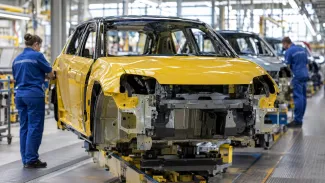
What Renault announced
Of the 2,000 new positions, 1,650 are for skilled workers in assembly, 250 for production support and 100 for training programmes aimed at university graduates. On the other side, up to 1,000 office-based employees will leave through voluntary severance agreements and early retirement. Renault says it does not plan compulsory redundancies.
The package is being presented under the label “France Industrie FutuREady”. Negotiations with the unions over the office job cuts are scheduled to begin at the end of November, according to Reuters.
The plant list leaves 200 positions unassigned
Charvet gave a breakdown for the 1,650 assembly jobs, as reported by Les Échos. Douai gets 600, Maubeuge 250, Sandouville 300 and Batilly 300. Add those four and you get 1,450. The remaining 200 positions were not attached to any site in the figures presented to the unions, and the reports do not say where they will go.
That gap may turn out to be administrative detail rather than a story. It is still the kind of thing worth tracking: a hiring plan is only real once each position has a plant, a shift and a start date attached to it.
Two thousand in, one thousand out
Net employment across the French industrial and administrative footprint therefore rises by roughly 1,000 by 2028, if every announced hire happens and every departure is voluntary. The mix changes too, shifting the balance towards the shop floor.
There is a practical reason. Douai has gone from one shift per day to three in about two years, driven by demand for the electric R5 and Scénic. That ramp-up was largely staffed with temporary workers. Converting temps to permanent contracts is cheaper than recruiting from scratch, and it is what the plan does first.
Ten billion euros, 2,000 jobs
In October, Renault announced an investment programme of more than €10 billion in its home market over five years, focused on electric vehicles and more affordable models. Dividing €10 billion by the 2,000 production jobs gives €5 million per position. That figure is arithmetic, not economics: the money covers tooling, battery supply, product development and plant modernisation, not just salaries. It does show the scale of capital behind a hiring plan this small in headcount terms.
Douai versus Trnava
The geography is the interesting part. Renault keeps volume electric hatchback production in France. Stellantis builds the Citroën ë-C3, its direct rival in the small electric class, at Trnava in Slovakia, where labour costs are lower. Renault's choice to expand in Douai, Maubeuge, Sandouville and Batilly is a bet that French production can hold its cost position on smaller cars.
Batilly (SOVAB) is Renault’s light-commercial-vehicle plant, building the Master in more than 350 versions at roughly 715 vehicles per day. The 300 assembly jobs allocated to Batilly therefore feed Master/LCV output rather than the R5/Scénic line — which is why the plan mixes passenger-car and van sites.
What it changes for a buyer
More shifts and more permanent staff usually shorten delivery times. That matters for anyone waiting on an R5 or Scénic, and it matters for the used market three years out. If you are working out the running costs of a small electric hatchback against a petrol equivalent, our charging cost calculator takes your own tariff and consumption and returns €/100 km.
For long trips, our supercharger database lists charging sites across Europe, with the cheapest sites separated out. Pricing varies enough between networks that the difference over a 1,000 km holiday drive is not trivial. Model specifications for the cars built at these plants sit in our EV catalog.
What is not settled
Whether 1,000 office employees will accept voluntary terms is not something an announcement settles. Voluntary departure schemes sometimes undershoot, and the unions have not yet opened negotiations. The 200 unassigned assembly positions have no site. Talks begin at the end of this month.
Source: https://www.electrive.com/2026/11/17/renault-to-create-2000-new-jobs-in-ev-production/