
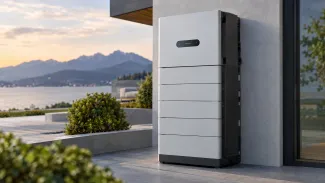
Specifications Huawei published
Single-phase versions run from 3 kW to 10 kW, three-phase versions reach 20 kW. The smallest configuration is 5 kWh with a 3 kW output. Every additional LFP module adds 7 kWh. Three 20 kW units in parallel give 60 kW of inverter output, and Huawei quotes a 336 kWh ceiling when several systems are linked together.
Cooling is passive, with a claimed noise level below 29 dB. The enclosure is rated IP66 and C5-M for corrosion. Operating temperature spans –25 °C to 60 °C. The inverter uses a full silicon carbide architecture; SiC parts switch faster and produce less waste heat than silicon IGBTs, which is how the cabinet stays compact without fans. Huawei gives no round-trip efficiency figure, only the claim that the system is smaller, lighter and quieter than earlier designs.
20 kW into a 3×25 A house connection
A common Czech family house has a 3×25 A main breaker. That works out to 25 A × 230 V × 3 phases = 17.25 kW, and the same limit applies in reverse when an inverter pushes power back into the grid.
The 20 kW three-phase version needs roughly 29 A per phase. Running it at full output means a 3×32 A connection at 22.08 kW, or a load-management agreement with the local distribution operator. That is an installation cost, and it lands on top of whatever the Luterra S2 itself will cost.
Output and capacity are easy to mix up. At 20 kW, the 5 kWh base pack is empty in 15 minutes: 5 ÷ 20 = 0.25 h. The high power rating matters for starting a heat pump or an induction hob during an outage. It does not turn the small configuration into whole-house backup.
What 7 kWh does for an electric car
Take a family EV at 18 kWh/100 km and 15,000 km a year. That is 2,700 kWh pulled from the home charger over twelve months.
One 7 kWh module cycled once a day has a theoretical ceiling of 7 × 365 = 2,555 kWh a year. At roughly 90% AC round-trip efficiency the usable figure is closer to 2,300 kWh. A single module therefore covers about 85% of that car's annual energy, provided every cycle is filled by solar or a cheap off-peak tariff and every kWh is consumed at home.
The cost side is easier to pin down than the storage side. At €0.25/kWh, 18 kWh/100 km costs €4.50 per 100 km. A petrol car at 6.5 l/100 km and €1.50/l lands at €9.75 for the same distance. Our charging cost calculator runs those figures on your own tariff, and the EV catalog has consumption data for 67 models if you want a different starting point.
Tesla Powerwall 3 as the reference
Powerwall 3 stores 13.5 kWh and delivers 11.5 kW continuously. One unit holds almost three times the 5 kWh base Luterra configuration in a single cabinet. Huawei answers with modularity: 5 kWh, 12 kWh, 19 kWh and upward on the same inverter.
On power the two are not directly comparable. Powerwall 3 is a single-phase product, while the Luterra S2's 20 kW is a three-phase rating. A Czech house with a three-phase heat pump and a three-phase wallbox is the case where the Huawei number means something.
Questions the launch left open
No price. No European delivery date. No round-trip efficiency. No cycle count or warranty capacity guarantee. The –25 °C rating describes operation, not charging: LFP cells generally need to be above freezing before they accept current, and Huawei has not said whether the pack heater covers that. The 336 kWh ceiling also comes without a unit count, beyond the three-unit parallel example.
What to check before ordering anything
Size the storage in kWh from your own consumption, not from the inverter rating. Confirm the main breaker and ask the distribution operator whether 20 kW of export is allowed. Get round-trip efficiency, cycle warranty and backup switchover time in writing, not in a slide.
Huawei already sells residential storage in Europe through its LUNA series, so a sales channel exists. That is not a launch plan. Chinese manufacturers keep splitting product lines by market, as the China-only VW ID. ERA 5X shows, and disputes between Chinese and European manufacturers now reach EU courts, as in the JLR and BYD document ruling.
What remains is the specification table: 5 to 336 kWh, 3 to 20 kW, IP66, passive cooling, –25 °C to 60 °C. Huawei has published nothing on European price, certification or delivery.
Source: https://electrek.co/2026/11/14/huawei-set-to-challenge-tesla-powerwall-with-new-20-kw-home-battery/