
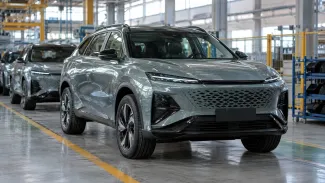
Egypt has assembled vehicles before, but not electric ones. The Mage EV is an all-electric SUV built in a partnership between the Chinese manufacturer Dongfeng, the local importer SN Automotive and the Safi Group, using workshops that El Nasr Automotive has modernised for the job. Prime Minister Mostafa Madbouly and Industry Minister Khaled Hashem presented the plan behind it: less dependence on imported cars, new factory jobs, and eventually exports to the Middle East and Africa.
What the Mage EV offers
The numbers place it in the compact SUV class. The body is 4.67 metres long, 1.90 metres wide and 1.61 metres tall, with a 2.78-metre wheelbase. A single motor on the front axle produces 120 kW and 240 Nm, enough for 0 to 100 km/h in 8.7 seconds. The battery is a lithium iron phosphate pack of 50.8 kWh.
Inside there is a 10.25-inch display behind the steering wheel and a 10.4-inch portrait screen in the centre for infotainment and vehicle settings. The "Aeolus" lettering on the steering wheel is the international name of Dongfeng's Fengshen sub-brand, under which the same car is sold in China.
45 per cent local content at the start
That figure is the one to watch. Egypt's National Programme for the Development of the Automotive Industry (AIDP) gives manufacturers financial benefits and softer regulatory requirements, on condition that they raise the share of locally made parts over time. Starting at 45 per cent means the Mage is not simply a kit car bolted together in a shed. It also means more than half of the value still leaves the country.
The charging numbers behind the datasheet
Dongfeng quotes 28 minutes for a DC fast charge from 30 to 80 per cent. In that window the car takes 25.4 kWh on board, which works out at an average of roughly 54 kW across the whole stop. That is a modest figure: fine for a supermarket top-up, slow for a family crossing a country on holiday.
For home charging, going from 10 to 80 per cent means putting 35.6 kWh into the pack. At an assumed €0.35/kWh that is about €12.45 for the session. You can put your own tariff into our charging cost calculator to see what the same amount would cost where you live.
Range measured on a Chinese cycle
The 445 kilometres in the datasheet come from the Chinese CLTC test cycle, which is generally kinder than the WLTP figure European buyers are used to. Divide the battery by the range and you get 11.4 kWh/100 km, a lab number that no driver will match at motorway speed or in winter. Treat the 445 km as an upper bound and use our range calculator if you want to see how a pack of this size behaves on a realistic route.
Space for a family
The boot holds 360 litres. For a car of this length that is tight. The Mage EV's 4.67 m length, 360 l boot, 120 kW motor and 50.8 kWh battery can be set against the Volkswagen ID.4, which is 4.58 m long, quotes 543 l of boot space, uses a 52 kWh base battery and starts at around €40,000 in Germany. On paper the powertrain and battery are close; in luggage space the Mage is far behind. A pushchair plus a week of luggage will fill the 360 litres quickly. Our EV catalog lets you compare boot volumes and dimensions across models side by side.
Export plans and the European comparison
Egypt's ambition is to become a supplier for the Middle East and the whole African continent, not just to serve its own market. The same tension between cheap assembly and deep local content is being worked out in Europe at the moment. The Bruegel think tank estimated that the EU's battery sourcing rules could add around €2,100 to the price of a 60 kWh electric car built in Europe. Cairo's 45 per cent starting point sits on the same sliding scale, and the AIDP is designed to push it upward.
Price and launch date
SN Automotive and the Egyptian government plan to put the Mage EV on sale in the first quarter of 2027. The Egyptian price has not been announced. The €15,000–24,000 figure is not an Egyptian or European price: it is a conversion of the Chinese price of the Dongfeng Fengshen Sky EV01, the same SUV as sold in China. Egyptian buyers will also have to wait for the charging network: a 50.8 kWh pack and 54 kW average charging speeds only make sense if there are enough public points along the routes people actually drive.