
What the livestream showed
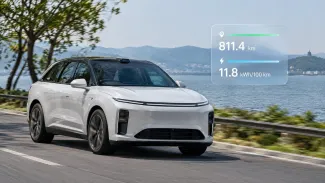
Li Auto sent the i6 around Lake Tai in the Yangtze Delta and kept driving until the state of charge reached 0%. The trip ended at 811.4 km. Average consumption of 11.8 kWh/100 km works out to 95.7 kWh taken from a 96 kWh pack, so the arithmetic is consistent. Li Auto says the car was still moving at that point, at reduced power.
The load was not empty. Four people on board, their luggage, another 50 kg of gear, and air conditioning running for the entire 18 hours. Divide 811 km by 18 hours and the average speed comes out at 45 km/h.
Why 811 km is not a motorway number
Speeds stayed between 40 and 80 km/h the whole way. At those speeds aerodynamic drag barely matters, and the car spends much of the run recovering energy instead of pushing air aside. Air temperature between 13 and 20 °C is close to ideal for a lithium-ion pack: no heating load, no fan at full speed.
The official numbers it beat are 780 km on the Chinese CLTC cycle and roughly 640 km on the WLTP equivalent, a gap of almost 27%. Neither rating is measured the way the Lake Tai loop was measured, and the CLTC cycle in particular is known for generous results at low speed.
My own estimate for a European motorway run: consumption roughly doubles at 130 km/h, to somewhere between 20 and 23 kWh/100 km. On 96 kWh that is a range of about 420 to 480 km. That is arithmetic on an assumption, not a measurement. If you want to run the numbers for your own commute, our range calculator uses the same method.
The battery, the cells and the silicon carbide
The refreshed i6 is the first Li Auto model that does not use CATL cells. Li Auto designs the pack itself, called Lian Shan, and buys cells from CALB and Sunwoda, then assembles them in its own plant. The Chinese outlet Dian Dong Che Zhu Ren reports that the new layout fits an extra 3 kWh of cells into the same space, and that revised current paths in the silicon carbide power modules add about 30 km of winter range. Those two figures come from a third-party report, not from a test we ran.
The pack is rated for 5C charging. On 96 kWh that implies a theoretical peak near 480 kW, though the real peak depends on the charger and on how long the car can hold it. Infrastructure is catching up: Chery has started installing its 1.44 MW Volt-Dragon charger in China, and Huawei's Yinwang has joined CATL's swap network with 2,520 stations.
Li Auto also promises the Lian Shan pack will never self-ignite or combust in a collision, and offers a free new car if it does. Xiaomi made a similar pledge with its Dragonscale battery. A promise like that is a marketing instrument as much as an engineering one; the pack design either supports it or it does not.
What 11.8 kWh/100 km costs
At a home tariff of €0.25/kWh, 11.8 kWh/100 km comes to €2.95 per 100 km. A petrol SUV at 7 l/100 km and €1.50/l costs €10.50. Over 15,000 km the difference is about €1,130 in favour of the electric car.
Fast charging changes the picture. At €0.60/kWh the same consumption costs €7.08 per 100 km, still cheaper than petrol but no longer dramatic. And 11.8 kWh/100 km is an urban figure. At 130 km/h, at the 22 kWh/100 km I estimated above, home charging costs €5.50 per 100 km. You can plug your own tariff into our charging cost calculator, and the cheapest chargers list from our database of 483 European locations shows what fast charging actually costs on the road.
Europe gets the Li 6 in Q1 2027
Li Auto plans to sell the i6 in Europe under the name Li 6 from the first quarter of 2027, with interface support for eight European languages. No European price has been published. Chinese-built battery-electric cars have faced EU countervailing duties on top of the standard 10% import tariff since October 2024, and that will shape the sticker price as much as the battery cost does.
The obvious rival is the Tesla Model Y. Tesla quotes up to around 620 km WLTP for the Long Range rear-wheel-drive version, on a pack roughly 20 kWh smaller than the Li's. Comparing the two on WLTP efficiency rather than on range is the fairer exercise, and the Model Y has years of independent motorway and winter data behind it that the i6 does not.
What a buyer should do with this
Treat 811 km as evidence that the i6 is efficient at low speed in mild weather, which is genuinely useful for city and suburban use. Do not treat it as a motorway range. When European pricing arrives, compare the WLTP consumption figure, not the range number, against the Model Y and against whatever else sits in the same price bracket. Then check a winter test.
Li Auto has not published a highway consumption figure for the i6, and the European WLTP rating for the Li 6 will only be confirmed closer to launch.